
This move comes at a time when many individuals under sanctions are attempting to re-enter the public debate
In December, the company Ealixir One ordered AyiboPost to remove the name of businessman Reynold Deeb from an article published in 2022 about the motivations behind the United States sanctions regime.
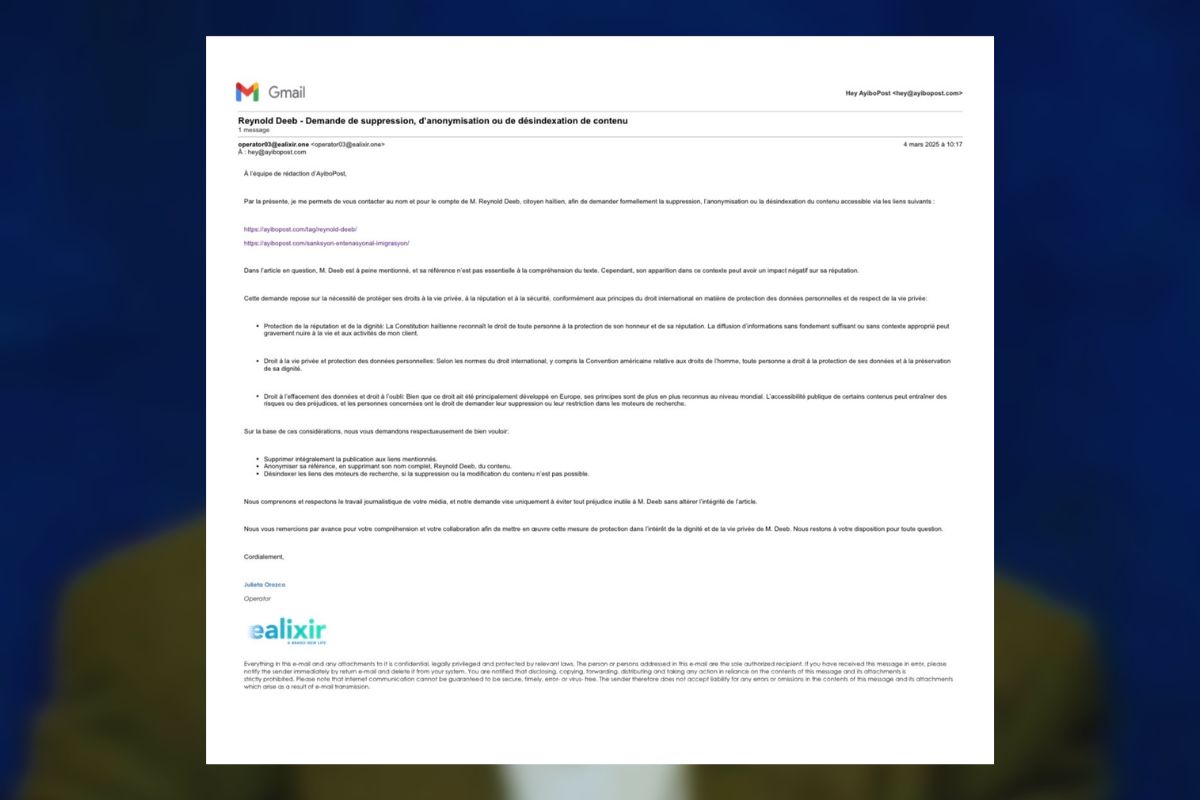
“In the article in question,” continued the company—specialized in reputation laundering and the removal of negative content—“Mr. Deeb is barely mentioned, and the reference to him is not essential to understanding the text.”
However, Ealixir One added, the appearance of Deeb’s name in this “context may have a negative impact on his reputation.”
AyiboPost conducts its journalistic work independently. Ealixir One’s request runs counter to its editorial charter and was therefore ignored.
This request nonetheless comes in a particular context.
The roughly forty high-profile figures in politics or business sanctioned by Canada, the United States, the United Nations, or the European Union have largely remained silent since 2022. As elections approach, many of them are now striking back with growing vehemence.
Some have unsuccessfully attempted to have their names legally removed from the infamous lists; others, like Deeb, pay lobbyists to obtain favors from the governments behind the sanctions. A final category—one that includes former Prime Minister Laurent Lamothe—has taken to the media to defend itself and to threaten legal action against the authors of what it calls “slander.”
The current government—implicated in several corruption scandals—published a decree in the official gazette in December that, in practice, bans investigative journalism and the disclosure of negative information about public figures.
Lamothe, sanctioned by the United States for allegedly embezzling 60 million U.S. dollars in public funds, welcomed the publication of the decree. An extraordinary text in a democratic society, it was condemned by local organizations and by the Inter-American Commission on Human Rights (IACHR).
Reynold Deeb, a controversial businessman, was sanctioned by the Canadian government for financing armed gangs, participating in money laundering, and contributing to corruption.
Deeb and his politically connected family now rank among the country’s most powerful economic groups, after rapidly amassing considerable wealth through import activities over the past decades.
According to a report by a United Nations Panel of Experts published in 2023, Reynold Deeb used gangs to “put pressure on certain port customs officers so that his containers would not be inspected or intercepted, allowing him to evade certain import duties.”
The United Nations also says it has evidence that Deeb, chief executive officer of the Deka Group—one of the country’s main importers of consumer goods—finances gang members to protect his business and ensure the transport of the goods he imports.
Despite changes in government, the General Administration of Customs has not indicated that it has taken steps to recover the sums allegedly unpaid to the state by Deeb.
And despite specific allegations, sometimes quantified and dated, very few of those sanctioned have been arrested by Haitian authorities.
“Individual sanctions have certainly had a ‘name and shame’ effect, but their concrete implications have remained limited,” Jake Johnston of the Center for Economic and Policy Research (CEPR) told AyiboPost.
The harshest sanctions have targeted armed group leaders—individuals already largely excluded from the international financial system and therefore little affected by these measures.
A few figures have lost their Canadian or American visas. A recent AyiboPost investigation suggests that businessman Andy Apaid, sanctioned by Canada in 2023, lost at least one contract in that country.
Meanwhile, the American researcher continues, “many high-profile figures involved in corruption and support for violence—some of whom live openly in Florida in multi-million-dollar villas—remain untouchable.”
Deeb has filed a legal action seeking the removal of his name from the sanctions list. Canada rejected this request in December of last year. In this case, the businessman revealed that he was contacted by the Canadian embassy in Haiti after being sanctioned, in order to assist with evacuation efforts for certain Canadian citizens.
The Canadian judicial system transferred part of this case file to AyiboPost. We are making these documents available to the public. Deeb was unsuccessfully contacted prior to the publication of this article through two public email addresses associated with his company.
The first uses of sanctions date back to 1991, when the Organization of American States, followed by the European Community, imposed an embargo after the military coup against President Jean-Bertrand Aristide. These sanctions were lifted in October 1994, according to Ayiti Nou Vle A in a 2023 report on the subject.
In the document, ANVA highlighted the “capacity of sanctioned individuals to circumvent restrictions, and the lack of interest shown by the Haitian government in very serious allegations of acts committed on its territory.”
To maximize the effectiveness of sanctions, according to ANVA, it is “imperative to adopt a proactive, transparent, and collaborative approach. This requires the involvement of the international community and local actors, particularly civil society, as well as the establishment of a competent Haitian task force to facilitate the local enforcement of sanctions.”
In reality, sanctions have become a subject of controversy in Haiti. While most of the individuals mentioned have been known for years for their links to organized crime, others claim they were targeted without evidence because of their political positions.
“Because of the manifestly political nature of these sanctions—as shown by their explicit use by the United States in recent weeks—[these sanctions] are more likely to destabilize the country than to address the root causes of the current crises,” according to Johnston of CEPR.
“Sanctions,” the researcher adds, “serve as a tool for the United States and other foreign powers to choose winners and losers [in Haiti]. Make no mistake: they are no substitute for genuine accountability.”
By : Widlore Mérancourt
Download part of the Deeb file released to AyiboPost by Canadian authorities.
Federal Court between Reynold Deeb
Minister of foreign affairs and the Attorney Genaral of Canada
Federal Court between Reynold Deeb 02
Federal Court between Reynold Deeb 03
Cover : Photo of businessman Reynold Deeb. Photo: Unknown
► AyiboPost is dedicated to providing accurate information. If you notice any mistake or error, please inform us at the following address : hey@ayibopost.com
Keep in touch with AyiboPost via:
► Our channel Telegram : Click here
►Notre Channel WhatsApp : Click here
►Our Community WhatsApp : Click here




Comments