
Most fire hydrants in Port-au-Prince are rusty, blocked or completely covered by asphalt during improvised roadworks, according to AyiboPost’s findings
Of the seven fire hydrants in the Port-au-Prince metropolitan area, only one is still functional.
Fire hydrants—also called hydrants, standpipes, or fire hydrants—are essential firefighting devices. Connected to an overhead or underground network, they provide pressurized water intakes that supply water directly to firefighters’ trucks.
Fire hydrants are a crucial element of any urban infrastructure to protect the population against fires, explains Jeff Georges, commander of the Port-au-Prince City Hall Fire Department (SIM-PAP).
A city lacking these essential emergency supplies providing rapid and direct access to water is therefore vulnerable.
In many countries, there are clear technical regulations governing the installation and operation of fire hydrants.
Read more: Port-au-Prince Fire Department Is Dying Slowly
In Haiti, there are no official provisions on this issue. The National Building Code of Haiti (CNBH) addresses certain aspects related to fire protection, but makes no explicit mention of infrastructure such as fire hydrants.
In the dusty and crowded streets of Port-au-Prince, it is difficult to notice the presence of the old fire hydrants.
According to AyiboPost’s findings, most of them are rusty, blocked or even covered by asphalt during improvised roadworks.
Of the seven fire hydrants in the Port-au-Prince metropolitan area, only one is still functional.
Among the fire hydrants still visible in the jurisdiction, the SIM-PAP manager cites those of Magloire Ambroise (in the vicinity of Carrefour-Feuilles), rue Oswald Durant, rue Roy, avenue Magny, route de Bourdon, Turgeau and rue Marcadieu.
« But of all these installations, only one remains functional: that of Turgeau, which supplies water only three times a week, from 7 a.m. to 9 a.m., » explains Georges.
The situation is not much different in the municipalities surrounding Port-au-Prince.
In Delmas, Joasil Jean Ronald, commander of the Delmas Fire Brigade and Emergency Response Center, admits he doesn’t have exact figures on the number of fire hydrants in the town. He estimates there are about ten, but points out that none are operational.
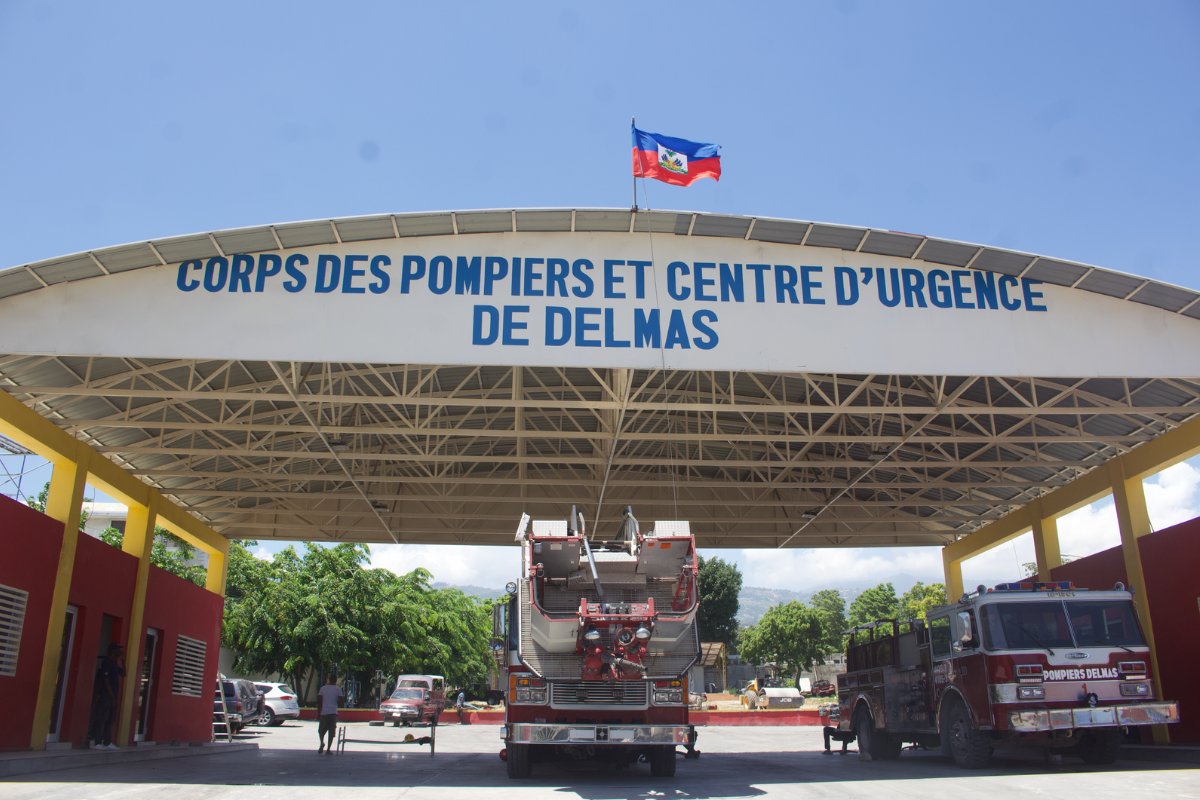
Photo : Jean Feguens Regala
In Pétion-Ville, the same observation is made. Maxo Joachim, commander of the town hall’s fire department, doesn’t remember the exact location of the town’s fire hydrants. « It’s difficult to find them because some are blocked by garbage or covered by street activity, whether it’s businesses or gas stations, » he explains.
Joachim, however, remembers seeing two: one located on Métellus Street, near the National Directorate of Drinking Water and Sanitation of Haiti (DINEPA), and another whose exact address he no longer remembers. « The one near DINEPA can still provide water, but only if you request DINEPA to open it, » he adds.
A resident of the commune of Carrefour reported to AyiboPost the existence of a fire hydrant located in the vicinity of Diquini 63. “I don’t think it works, and you really have to be attentive to notice it, because it’s located in the middle of the vendors set up along the street,” describes this resident, who says he doesn’t remember seeing any others in the commune.
In Delmas, Joasil Jean Ronald, commander of the Delmas Fire Brigade and Emergency Response Center, admits he doesn’t have exact figures on the number of fire hydrants in the town. He estimates there are about ten, but points out that none are operational.
In 2019, DINEPA, with funding from the Inter-American Development Bank (IDB), planned to install 125 fire hydrants in the Port-au-Prince metropolitan area to ensure water availability in the event of a disaster. But this project never saw the light of day.
AyiboPost was unable to obtain any concrete information on the status of this initiative.
But this situation is not isolated. Rather, it constitutes the visible part of the functioning of the fire service sector in Haiti, an area further weakened by widespread insecurity and the lack of supervision.
Placed under the supervision of the Haitian National Police (PNH), the country’s fire services operate in an extremely precarious environment.
This reality, combined with the difficult working conditions of firefighters, is part of a context where several neighborhoods of Port-au-Prince remain particularly vulnerable to the risk of fire.
Jeff Georges, commander of the SIM-PAP barracks since December 2024, describes to AyiboPost the harsh reality of the daily lives of his men and women.
« We are working in an extremely difficult context, marked not only by water supply problems, but also by insecurity, » he explains.
Placed under the supervision of the Haitian National Police (PNH), the country’s fire services operate in an extremely precarious environment.
Interventions often take place in high-risk conditions. « We don’t have bulletproof vests or armored vehicles. Sometimes we’re called to areas where the police are directly confronting bandits, » Georges continues.
In particular, he recounts an experience that occurred two weeks ago, near Babiole.
That day, his men had to intervene on foot to extinguish a fire started by bandits in three homes, even as gunfire erupted all around.
Joasil Jean Ronald, head of the Delmas Fire Brigade, acknowledges that his team’s scope of action is now considerably reduced compared to previous years.
« Previously, the team could intervene in all surrounding areas—whether in Cité-Soleil, lower Delmas, or other neighboring neighborhoods. But today, that’s no longer possible. We have to limit our interventions to places where our men’s lives are not directly threatened, because we are not armed and our vehicles are not armored, » explains Jean Ronald.
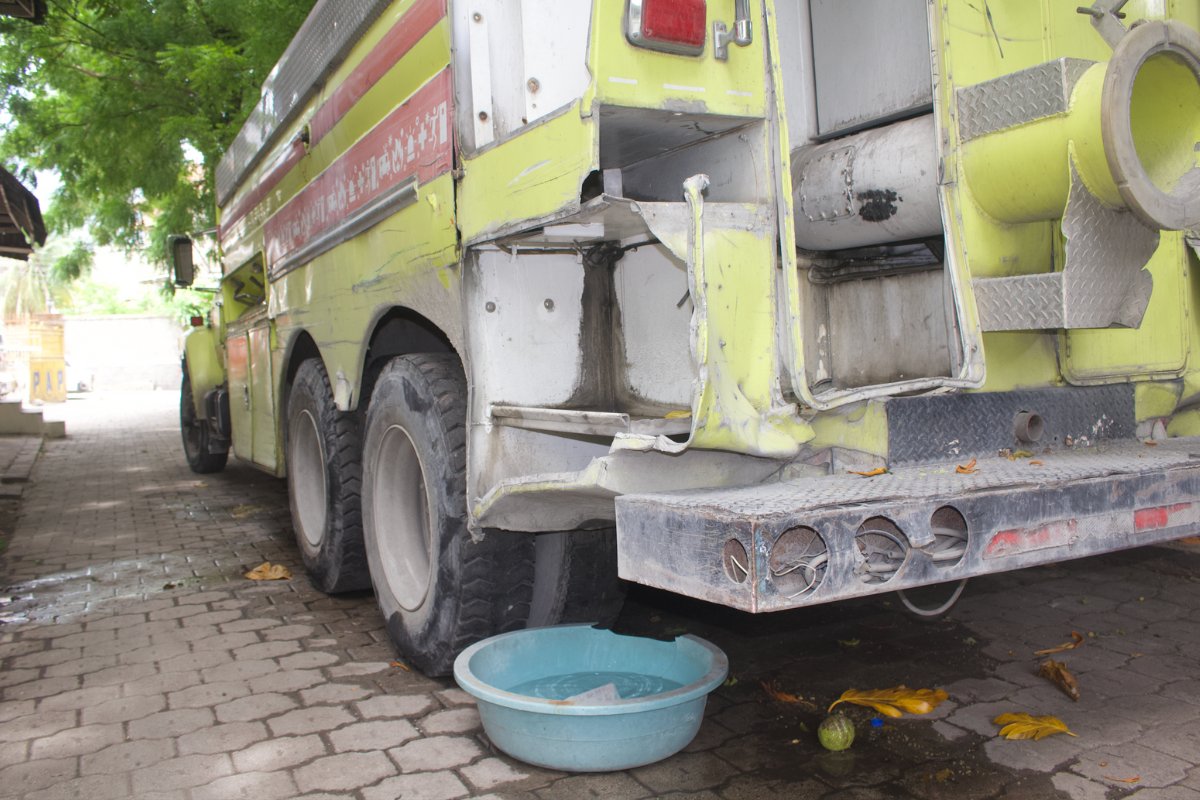
Photo : Jean Feguens Regala
He recalls a particularly striking incident in December 2024, which nearly cost the lives of eight of his firefighters. “We were informed of a fire at the Bernard Mevs Hospital. After working diligently to bring the fire under control, we were ambushed by bandits who were still on the scene,” he says. “We barely escaped,” he adds.
The sector is not only weakened by insecurity, but also by a glaring lack of operating resources.
To get water, SIM-PAP is forced to travel nearly twelve kilometers, to Boulevard du 15 Octobre in Tabarre, in order to fill its trucks.
An operation that can be repeated several times a day, as soon as several fires break out and the tanks empty. The fire station’s fleet only has two vans: one with a capacity of 3,500 gallons and the other with a capacity of 1,000 gallons.
« Every time a fire breaks out, the scene repeats itself: the firefighters arrive quickly, but their outdated trucks empty within minutes. The onboard tanks can only hold a limited amount of water. Once empty, we have to go back and look for new supply points. But there are practically none in the capital, » explains Commander Georges.
« Previously, the team could intervene in all surrounding areas—whether in Cité-Soleil, lower Delmas, or other neighboring neighborhoods. But today, that’s no longer possible. We have to limit our interventions to places where our men’s lives are not directly threatened, because we are not armed and our vehicles are not armored, » explains Jean Ronald.
It was 2 a.m. a few months ago when a fire broke out in Lalue. « We contacted the Delmas town hall, but no team was able to intervene due to a lack of authorization to travel at that time. It was thanks to the cooperation of the population that we were finally able to bring the fire under control, » Georges continues.
The case of the Pétion-Ville town hall fire brigade is even more worrying.
According to Maxo Joachim, who has been in charge of the institution for eight years, the last operational fire truck broke down about eight months ago. « If a fire breaks out in the commune of Pétion-Ville, we, as the fire brigade based here, simply won’t be able to respond. »
According to his explanations to AyiboPost, the Pétion-Ville town hall only had two vans. Today, neither is functional. « The fire station is poorly equipped, its infrastructure is unfinished, there isn’t even water on site for the firefighters’ personal hygiene, and no daily food is provided, » describes Joachim, who leads a team of nineteen firefighters under his responsibility.
Adding to these already precarious working conditions is the almost non-existent social support for firefighters. Port-au-Prince’s firefighters describe themselves as « unarmed soldiers. »
The work of firefighters is not limited to fighting fires. They also respond to road accidents and natural disasters, to name just a few examples.
But their action remains largely limited due to the lack of equipment.
« We don’t have essential extrication tools, which are essential when responding to road accidents, » according to Georges.
But it’s the human conditions that are most striking. A basic firefighter earns between 17,000 and 25,000 gourdes per month, the equivalent of 130 to 190 US dollars—a paltry sum in a country where inflation has caused the price of basic necessities to skyrocket. With such a salary, it’s nearly impossible to cover a family’s basic needs, send children to school, or pay rent.
« We risk our lives to protect others, but no one cares about our survival, » confides Richardson Théogène, a firefighter for six years at SIM-PAP.
Adding to this meager income is the complete lack of social security coverage. Firefighters who are injured during an operation must cover their own medical expenses, which are often exorbitant compared to their standard of living. There is no health insurance system to protect them. « If we get sick or get injured on duty, we sometimes have to rely on our colleagues to find the money. Otherwise, we go without care, » says Georges.
« We don’t receive any help from the state, » he continues.
According to Richardson Théogène, a father, managing to put aside a little money is only possible through colleagues pooling their income.
Théogène earns his living exclusively from his job as a firefighter. « The state has stopped providing food to the fire stations for several months, » adds the professional, who, depending on his schedule, spends several days a week, 24 hours at a time, at the fire station.
Read also:Garbage, a new source of income for gangs in P-au-P-P
The consequences of these precarious working conditions are visible. In recent years, Port-au-Prince has been the scene of a succession of devastating fires. These include the devastating fire at the Hippolyte market in 2016 and the fire at the large La Croix-des-Bossales market in 2017.
In practice, firefighting is the responsibility of individual municipalities, while in theory it falls under the jurisdiction of the Haitian National Police.
« The fire service sector is generally treated as a poor relation. It is left to its own devices, without a general management responsible for the entire country. Each municipality acts on its own, which creates a real discord in the overall functioning of the sector, » notes Joachim, who advocates for the creation of a national management body for the supervision of firefighters in Haiti.
In a 2020 article, AyiboPost described the dysfunctional Port-au-Prince fire department headquarters, which had been left abandoned, filthy, and under-resourced. Located on Rue Légitime, near the Champ de Mars, the site is now in an area under gang control.
The central government, for its part, has never implemented a national policy for preventing and fighting fires.
By : Lucnise Duquereste
Cover | Firefighters and the emergency center of Delmas City Hall. Photo: Jean Feguens Regala
► AyiboPost is dedicated to providing accurate information. If you notice any mistake or error, please inform us at the following address : hey@ayibopost.com
Keep in touch with AyiboPost via:
► Our channel Telegram : Click here
►Notre Channel WhatsApp : Click here
►Our Community WhatsApp : Click here






Comments