
AyiboPost spoke with the U.S. Chargé d’Affaires in Haiti last Friday
What do the United States want in Haiti?
This question ran throughout AyiboPost’s interview with the U.S. Chargé d’Affaires in Haiti, Henry T. Wooster.
The interview, recorded on April 10, 2026, covers in particular security issues, the embassy’s relations with the current government and the private sector, as well as the United States’ long-term vision for Haiti.
Wooster has more than thirty years of experience at the United States Department of State. He has served as an ambassador, Deputy Chief of Mission, or political advisor in several countries. He had previously worked in Haiti between 1998 and 2000.
For clarity, the interview has been lightly edited.
Widlore Merancourt : Thank you, Ambassador. Thanks for being here. I appreciate the time. In your Senate hearing, more than a month ago, you said the US objective in Haiti is stability. That means no collapse of the state and no mass illegal migration to US shores. Beyond preventing collapse and migration, what is the US vision for Haitians themselves so they have a viable future in their country?
Henry Wooster : So you’re right, that stability we put is the paramount issue. Why? Because, as I think I said in that testimony, and certainly, as I would say now, if we don’t achieve that, in this current circumstance, where we have the threats we do against the state, all our conversations about what we would like are interesting, but they are academic rather than real.
So in this case, in terms of our interests, we want Haiti to have the responsibility for its own future. I know that can sound hokey, and at times, has sounded. Do you know the term hokey — can sound corny or a little— but that is, in fact, our policy. We want not to be having hands on things.
I know this runs sort of contrary to the conspiracies and some of the fantasies that people have about the depredations of the United States and all the things that we want to do and control and manipulate. We want Haiti to be in Haiti’s hands. We want the country to be in the hands of its people, whether its people are the people it elects, the people who run its commerce, the people who run its schools. Haiti is the project of Haitians and Haitian people. I’m not pointing to a socialist republic, per se, but what I am pointing to is this is a country and a sovereign enterprise and a sovereign project that is that of its people and of its populace. It’s not a project of the United States. It’s an ally of the United States, a friend of the United States.
How does Haiti fit into the broader US hemispheric strategy?
Well, I think every Haitian knows, and certainly all of your readers or listeners know, and all of us sitting in this room know, you guys are very close to our shores, right? Whether you measure it by flight time or you measure it by nautical miles, or however you measure it, you’re really close to us. So, we don’t have a choice. And I’m speaking here in a realpolitik, geopolitical sense, i.e., what most countries, when they think strategically, do. Who’s in our neighborhood? You’re in our neighborhood along with a lot of others, of course, but you’re in our neighborhood.
We don’t want anything in our neighborhood that’s going to be a threat. Or — threat sounds maybe a little dramatic — it’s not a threat, it’s a problem in the neighborhood.
We want the neighborhood to be pacific, peaceful, stable. If the neighborhood is also prosperous, lovely, and people are ecstatic with one another and with the United States, all the better.
But what we need, what we require for our own stability and security, is that our neighborhood is stable. That means economically. It means politically and in every other aspect.
That’s what we’re concerned about here in Haiti, and we would be concerned about that with anyone who is in our neighborhood, anyone who is close to our borders or our shores.
So that’s the objective here. We want Haiti to be stable, because it affects the stability, not only of Haiti qua Haiti, but it affects, obviously, Hispaniola. It affects, obviously beyond that, the region — the Caribbean, if you prefer that term.
And then it was out of fashion for a while, the notion of Monroe Doctrine and backyard, which had become impolitic, at least for the United States — now it is politic again, right? So, we want our neighborhood — I’m not going to use the word backyard, right — but we want our neighborhood, we want our region to be stable without concerns that will affect or harm our interests, whether they are commercial, economic or security, in the sense of physical security.
The current administration is pushing to end the Temporary Protected Status for Haitians. It’s also pushing for the end of other programs that allowed Haitians to live and work in the United States. You’ve been in Haiti for a while now. What do you think the impact would be if we were to have massive deportations to Haiti?
So, my job as an American diplomat, and certainly as chief of mission here, is to execute the President’s policy. That means there is a policy. He and the senior officials of the United States government who are empowered to make those decisions — and it’s true of all countries, but I can speak only officially for my own — they have made a decision. This is the policy. This is their choice. This is what we will be doing. My job is to execute that policy. So, the notion of what Henry Wooster thinks about something — in my professional world, honestly, while intellectually it’s a completely appropriate question, professionally it’s one that I can only point you to the policy. My job is to lead the execution and the implementation of that policy.
But don’t you think giving advice and counsel and feedback with regard to what the consequence of a specific policy could be, or might be, is part of your purview?
Yeah, it is part of my purview, and it’s a responsibility I take very seriously, and I expect my team to take very seriously. It’s our professional credo, right? We provide professional counsel, we provide our best professional judgment in all places, in all situations, and we should, and that should be an expectation of us as career diplomats. But it is the decision of the chief executive to make the determination about — thank you for your thoughts. Thank you for your feedback. Thank you for your input. Here’s what we’re going to do.
How many US private contractors are currently operating in Haiti, and what are they doing?
I don’t know how many are here, because how many are here and what they’re doing is a product of what the Haitian government has decided by virtue of its contractual relationship with that private entity. That’s not a relationship with the United States government. It’s not a payment of the United States government, not through Haiti to them, not to them. It’s entirely a project between the government of Haiti and that private military contractor. So, are we aware they’re here? And do we know they’re American, or at least the ownership of the company? Of course, just as we would if Boeing were here, or, you know, an investor were here in some other capacity.
Then tell us about the ones you know and what they are doing.
That is a private contractual relationship. But the public knowledge of what they’re doing here — if you mean the military or quasi-military role, right — they work under the Haitian Task Force. That task force reports to your government. They don’t report to us. They don’t work for us. We have an interest for the obvious reason that they are here to combat the gangs, right? That is an interest of the United States and a lot of other people.
I’m pulling this information from your Congress address. Is Erik Prince’s company Vectus Global the company operating the so-called kamikaze drones?
You’d have to go to the Haitian government about that.
But you didn’t dispute that…
No, and I don’t, and I don’t dispute it here. But again, the particulars of the relationship between a private military contractor, which happens to be a US company — that relationship, the functions and the particulars of the contract it has with the Haitian government, it’s a relationship between the Haitian government and that contractor. I am an interested observer. I have equities because, again, what they’re doing — which is combating the gangs — I’m and again, the United States government has an equity, because we’re all of us looking, and as is the Haitian government, we’re all — and the international community — we’re all looking at combating the gangs, reasserting the authority of the state. So, we’re interested in it. But again, the terms of the direction and what they do, what they don’t do — those particulars are not for me.
Are you saying you don’t know which company is using the explosive drones?
No, I’m not saying that. I’m simply saying that, rather than you and I go down a rabbit hole of — let’s talk about a US private military contractor — I’m telling you that the relationship…
But you are affirmative that it’s a US contractor using — I mean, dropping — the kamikaze drones.
A US contractor has a contract with the government of Haiti, and it has a contract to combat the gangs.
To combat the gangs and dropping the drones.
Yeah, I don’t think there’s any secret here about what they’re doing.
No — it’s because my next question is tied to it. Local doctors and human rights organizations say the drones help push back the gangs, but also killed dozens of civilians, including children. Are you concerned about civilian casualties caused by the so-called kamikaze drones dropped by US companies?
We are concerned about civilian casualties caused by anyone — primarily caused by the terrorist gangs, raping, murdering. The most recent example of which we had was what, last weekend, or a week ago, up in the Artibonite.
More than 70 people dead.
I mean, that is the kind — I would like to see the righteous — I would like to see the sorts of things I get, and the questions I get. I’m not talking just about you, but from anywhere, anywhere at all. I’d like to see a bit of that righteous anger. And it’s righteous because it’s real. When innocent people are harmed, whether they’re killed, they’re raped, they’re robbed, they’re bruised, their houses are destroyed, their property is taken or destroyed — that is wrong. It’s just wrong, right? That is in the book, that’s just wrong. All human beings can get that.
But I would like to see, every now and again, a little bit of the righteous anger directed at what I see very often: this sort of seduction of Barbecue, you know, being interviewed by all of the premier outlets worldwide, turning him into a Robin Hood figure. This is the kind of stuff that really cheeses me off, because while you are correct that if people are harmed, hurt, killed, wounded, or whatever the particulars may be — by whether it’s drones or any other such activity — yeah, that, of course, concerns us.
It concerns us also on a level that’s pragmatic, beyond the simple moral right and wrong. And the pragmatic aspect that concerns us is: when in a conflict zone, the people who are fighting on behalf of the state or the government start to harm the people who are not combatants in between, you risk driving people into the arms where you don’t want them to go. So yes, we’re concerned.
Then what does accountability look like for US companies and individuals involved in the killing of civilians in Haiti?
That’s a particular question that must be directed to those who hire them. So, whether the companies are Venezuelan, Singaporean, American, or whoever they may be, that’s a question to the organizations that hire them. In this case, your question is best directed — particularly on accountability — to the matter of the authority that hired them and has a contract with them, and that happens to be the state.
You don’t think there is a need for accountability for US companies…
I didn’t say that. That’s not what I’m saying. You’re extrapolating. That’s not what I said. What I said was: the accountability — because accountability is a specific mechanism and a measure — that accountability has to be taken between those who are conducting a duty and those who are paying them to conduct a duty. That’s where the accountability space lies, right. It’s not with me because there is an incidental fact that they happen to be registered as, or citizens of, companies — some of them are US. That’s incidental to the question.
You said in your address to Congress that they have a license from the US government to operate these drones and operate in Haiti. Don’t we have anything on the books to hold them accountable?
When you get into the delicate matter of licenses, you’re going to reach a limit about what I can talk about. But the good news for you is it’s not a limit about what anybody else can talk about. The Department of State — you know, we have different subsections, we call them bureaus. The bureau that handles licensing for things like this — weapons, ammunition, so forth — is the Political-Military Bureau of the US Department of State. I would direct you to them for the particulars of licensing. I would be exceeding my boundaries if I were talking about…
But do you think there should be accountability for US contractors killing civilians in Haiti?
You’re being very artful in your attempt to draw me on this, but I can tell you that this is a space where I’m going to draw a line. I’m going to encourage you to speak to those who hire them, not to me to comment, because it turns into commentary — because I don’t have an official relationship with them.
Do you have a relationship with Erik Prince?
I know who he is.
Do you talk to him?
Yes, I talk to him.
Do you talk to him about Haiti?
Well, more than I talk to him about Guyana or any place else.
Could you share what is the extent of the relationship between the US Embassy — you, in your official capacity — and Erik Prince?
Yeah, look, let me be very clear and frank with you. There is no secret agenda going on here. There’s no voodoo or magic that you’re not seeing, right? Erik Prince is an American citizen. He’s also an American business owner. Yes, his companies and so forth — or whatever, you know, shells or whatever they — I don’t mean like something inappropriate, I just mean one that’s called this that works in, say, the border, one that’s called this that does drones, what have you. Yes, they work here. But again, I can’t offer you commentary on a relationship I don’t have. That official relationship between the state of Haiti — who is paying him — and the work he does for them on their behalf, on the contract that you have, is not a space that I own. Do I have thoughts about it? I do. You know, any sentient being has thoughts. But that’s not an appropriate space for me to enter into here with you.
I’m happy you brought up the customs contract with Evergreen. Many lawyers we’ve talked to say this contract is unfair to Haiti because it will spark a massive transfer of wealth from Haiti to this private company. Are you concerned that these agreements may run counter to long-term US objectives in Haiti?
I’m not concerned, because anybody that would tell you that — and particularly if they would use the qualifier « massive » — clearly doesn’t know what’s in the contract.
Have you read the contract?
I’m familiar with the contract. The contract is not between us.
I understand. Do you think the contract is fair to Haiti?
Absolutely.
Why?
You’d have to look at the particulars. But again, anybody who makes the comment to you about — what was the term — « massive »? Clearly anybody who uses that phrase does not know what’s in the contract.
Was the US Embassy involved in this contract?
You know, you and I aren’t going to get very far if we keep talking all the time about Erik Prince, because that’s Erik Prince. That isn’t my work here. Erik Prince is a private American doing work here.
I’m thinking about your long-term objectives and even your short-term objectives. And I think there is a link between these contracts signed with the state, these actions by these US companies, and what the US claims are its goals in Haiti.
Be more explicit.
You say you want stability, and you want the state to provide stability and not to collapse. Historically, the Haitian state has been captured by all sorts of entities, including from the private sector. And analysts we talked to say this is a continuation of the same old playbook of private companies coming into Haiti and practically ripping off the country. What do you answer to that?
I’m familiar with that analysis, if we can call it that. It’s a remarkably prejudicial analysis that puts often emotions, ideologies, agendas foremost, and then reverse-engineers out of that to try to get things that will reinforce that perception or that conviction, as the case may be.
And there’s a difference between those who believe it as a perception — they perceive it and they think this is the case — and those who have it as a conviction, which is kind of like — you mentioned, I think before, a certain religious background, right? See, I’m going to assume you have a basic familiarity with people who take that very seriously — a conviction that’s nearly religious in its nature, that believes — and that’s the operative word — they use a creedal definition of belief, rather than one that’s more analytical in its nature, which is: let’s take a look at what we have for data. To use the modern term — facts, maybe a little passé these days — but let’s look at what we see, right? What do we have here? Look at that and then do your math. Take your variables, and come out with the sum. My concern when I hear these kinds of things is that we’ve started the other way around, right? Which is: let’s take our prejudices — and our fears, to be fairer, our anxieties — let’s take those and let’s lead, sometimes consciously, sometimes unconsciously. Let’s lead with that and color everything with that.
The US, in multiple statements, says it aims to curb gun trafficking into Haiti. What strategies are currently in place? What can you tell us about what results have been achieved?
If I tell you that we all know — meaning you and we know — that a good number of weapons that flow into Haiti come from the United States. I don’t think that’s a news story to anyone, right? And we all know, regrettably, that’s true.
What we don’t know is how much. So, what’s coming into Haiti from, let’s say, the Port of Miami, or wherever it comes from in the States — but the States, let’s just say, from the US — and how much might come from, say, Colombia or, I don’t know where. I don’t know, and I guarantee you, there’s no one who knows for a fact, because no one really has the whole 100% picture, right?
You’ve got a piece, she’s got a piece, I’ve got a piece, and the next guy, right?
But we know that, unfortunately, more weapons than ever — no weapon needs to be coming here illegally from the United States, and we’ve got too many coming here. That’s something we know. What’s the now? Where do we go from there? Do we go still further down, or do we move in a more affirmative direction?
I can tell you we are moving in a more affirmative direction, but it’s not where it needs to be. So, the source of weapons — let’s take the US as one of the big sources. Again, noting and acknowledging there are other sources, but let’s say the US. At the moment, we know they come mostly through the sea. They come here. Perhaps some come via one or another small aircraft or something — I would be speculating. They come here, and they come to the Dominican Republic, and they get over land here to Haiti.
I don’t know how many versus how many — you know, one versus the other, coming to one shore versus the other. I do not know that. But what we do know is this: US authorities, US federal authorities, have begun cracking down more. And it’s not just — I want you to understand — it’s not merely a question of willpower. It is a question also — I don’t know how much you know about container cargo — I know more about it than I want to know about it. And container cargo, basically shipping, right? So, a ship that’s large — that has, you know, any one of us has seen them, it’s floating out at sea — it’s got God knows how many hundreds and hundreds of containers on it.
And if you’re in a port that’s anywhere near busy — and most all of them are busier than the capacity — the ability for you, or any one device or person or persons, to inspect all of the items with surety, with certainty, in every single container — if you’re in the safest and busiest ports in the world, anywhere, much less ports that aren’t the safest or aren’t the busiest — the math on that is not heartening.
But we have — US federal law enforcement agencies have increased the arrests. These are discoverable. We have also, I know, through the embassy here, publicized those of these federal investigations that have netted people who were shipping weapons. Additionally, while we’re on this scene, we have also been going after people — including elites — and we’ve been very deliberate about that, who have been also fueling this. Maybe they don’t go to the gun store or dealer or whoever and buy the weapon themselves directly, but they’ve been fueling this, and we have been very deliberate about targeting them and going after them, and we’re proud of that, and we only intend to continue that which we are doing. Not all of it makes the news every day, and we will continue. And we call it the same thing you did — you used the word accountability. That’s exactly what we call it, same thing. And by the way, all of this anchored in what I told you at the outset and what you noted from the hearing: stability, stability, stability. We can’t have it if we don’t have these kinds of things.
The US funded and supported the Kenyan-led multinational security mission. But according to many experts we talked to, the mission failed, and it’s now facing a sexual misconduct scandal. Do you believe the US bears some responsibility for this failure, given that many experts, before the mission came…
Which failure are you talking about?
The mission not reclaiming the territories it was supposed to reclaim, not reopening the main roads that it was supposed to reopen, and also now facing a sexual abuse scandal. Do you think the US bears some responsibility?
Look, everyone bears responsibility in these kinds of cases, right? Because this is a multilateral effort — or a coalition, if you prefer that term — effort. This is not a unilateral, entirely state-owned enterprise of any one state — Haiti, the United States, Kenya. These things are the products of multiple things.
Look, here’s the stuff that people don’t appreciate. I don’t know that we would properly call it a counterfactual, but this is the stuff that people don’t appreciate. And I will tell you I didn’t, when I first came here, until I — by force of obvious circumstance — had to become more aware: how did this happen? How did that happen? And I think it’s unfortunate that people — and I understand it as a human being, as distinct from my hat as a diplomat — I get why people are simply trying to find — do you know that expression, to pin a tail on a donkey? Right? People are trying to find a blame, you know, something they can pin their disappointment on. I get it as a human being on an emotional level, but professionally, I will tell you it’s a little more complicated than that. And the truth is, it’s actually a lot more complicated than that.
Well, but it’s important to unpack it, because I think your readers or your audience need to know, and also you. And that is that when this was first called for — this kind of a force — nobody was willing to do it. And the Kenyans, bless their souls, said, « We’ll do it. » So wait — wait, this, because this is important for people to understand. They said, « We’ll do it. »
Haiti, and anyone who cared about Haiti, was nearly desperate. Who’s going to do this? They said, send us. There’s a line from Isaiah — « Send me, » right — in any event, they said, I’ll go. Then the enthusiasm was such: oh, really, you’ll do this hard thing. Yes, we’ll do it. Oh, great. All you have to do is get on a plane and fly there. We’ll provide all this other stuff. Didn’t quite work out that way. Armored vehicles — there’s a longer story we won’t go into — about how this armor was not compatible with that one. So if you blew a tire on this one, that one couldn’t help repair it — the armor from here not compatible with that. It goes on. It goes on. My point being: laying this at the feet of the Kenyans isn’t entirely fair, and it’s not an appropriate treatment of them and their willingness to step up and do a job no one on earth was willing to do. They were willing to do it.
Where are we now with the Gang Suppression Force, and when are the most important operations scheduled?
We’re today at 10 April. On the first of April, nine days ago, the UN Support Office — UNSO is our government acronym — the UN Support Office Haiti took over exactly on schedule the operations it was supposed to take over, which is logistics, basically supply, right? Getting the toilet paper, the food, the beans, the bullets, all that stuff, right? The supplies. They took over exactly on schedule on the first of April, and that is in accordance with the UN Security Council Resolution.
Now the UN Security Council resolution said you need to achieve an initial operational capability, IOC in April, which the UN Support Office Haiti opening on schedule achieves. But we’ll come to the more consequential element, and you need to achieve full operational capability over the summer.
Meaning you go from an initial — we’re here, we own the operation, one April — to: we have all the troops, the 5,500 troops, plus 50 civilian staff. You need to have that all in place by the end of this first mandate, September 30 — basically, think of the summer. By the end of the summer, you need to have everybody, all the equipment from around the world, all the troops from around the world, and everything needs to be fully operational.
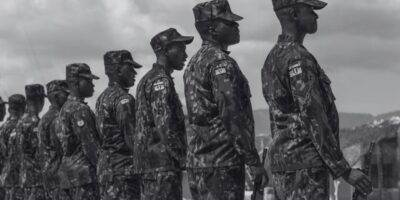
Now, initial operating capacity also means not merely the UN Support Office Haiti, but more consequentially, and probably of the greatest interest to your audience, troops and operations. They have begun arriving. I think you will have probably seen the pictures out here and so forth. But for reasons of operational security, I can’t broadcast math and numbers right now. But what I can tell you is this: we’re achieving initial operational IOC capacity or capability. We’re achieving that on schedule. We’ve got a little lag time. And you’re probably wondering, what’s a little mean? A little lag time means many people had in their head — oh, one April, you’re going to start operations. No. The resolution has us arriving here, which they did do. And the troops begin to flow. You get troop flow in here. Initial troops are here, and more are still flowing in. It’s going well. But remember, we’ve got a lot of moving parts. You’re moving troops from Mongolia, Chad, Sri Lanka, among other countries, Central America as well. You’re moving troops. You’re moving equipment — very heavy, big equipment, not just your boots and your helmet, but a lot of heavy military equipment. All that stuff has to flow into Haiti, whose airport is closed. So, it’s flowing. It’s complicated, but it’s moving along.
The US is currently running a public campaign asking for information on leaders of criminal groups in Haiti. Critics say the US has the capacity to locate and arrest these individuals. Are they wrong? Why is this not being done — to arrest and prosecute these people in the US?
Because we’re not putting boots on the ground down here. We’re not. We’re not, contrary to many of the traditional myths about, you know, hiding behind a tree somewhere in the Artibonite or here in Pétion-Ville or something. We’re not doing those things. What we’re saying is, if you do those things, we will reward you for doing it. But we’re not coming down to kick a door in, parachute out of the sky, or any of those things. We’re not doing that. We will reward those who will take the initiative or take the agency to do it. But we’re not coming to do it ourselves. Distinction with a difference.
In January, a majority of the Presidential Council voted to remove Prime Minister Alix Didier Fils-Aimé from power. On January 22, the State Department said the decision was, and I quote, « illegal. » Why was a similar move against Garry Conille not publicly criticized by the US?
I wasn’t around for Garry Conille. I know who he was, of course, but I wasn’t around for Garry Conille. I can’t tell you the particulars of what happened with Garry Conille, but I can simply say, in [Fils-Aimé’s case] it was obscenely and blatantly a political coup that was outside the law, outside the mandate, and outside — this is Haiti’s laws. Not mine, not the US. These are Haiti’s Constitution, Haiti’s laws. Every single guardrail that Haiti has about how that could be done was violated by that group, the TPC.
What do you say to those who question the US’s authority to declare what is legal and illegal in Haiti?
Well, we can’t declare it for you. But we can do what we did do, which was to say, in our judgment, our assessment — this was, just as I said to you, this was an outrageously, obscenely illegal act. Here’s your constitution. Here are your bylaws. Here’s everything that you use to guide and to guardrail how you function as a state, and you — the TPC — you are in violation of every single one of those by what you are attempting to do.
Fils-Aimé remains in power with no clear end date to his mandate. There is no parliament, no functioning justice system, no counterbalance to his power, and no fixed date for him to leave office. His term is increasingly criticized, including for contracts and purchases made with the private sector. What do you say to critics who argue the US is supporting a de facto dictatorship in Haiti?
I’ve been in countries where there are dictatorships, and I know what a dictator looks like, and I know what dictatorial behavior looks like. I don’t see it here. I would challenge anyone here to show me what that looks like, show me what they’re seeing and tell me — oh, well, here’s big dummy American, here’s what you’re missing. I don’t see it. I don’t see an extreme exercise of authority. I don’t see a violation of civil procedures or civil laws. I don’t see any of that.
I want to be very clear here: I’m not a campaign manager for the Prime Minister, right? He’s an ally. He’s the head of government here, and functionally, you know, de facto head of state as well, and he is our ally, and we work with him, and that’s a relationship that’s professional.
But I would also offer to you what I just said, which is people do these types of criticisms. They do it in the States as well, about political figures, right? It’s not unique to Haiti, but I know where these things proceed from, and they aren’t on the money. They’re not on target. The fact that you don’t like him — fair. The fact that you don’t agree with his politics — fair. The fact that you don’t, whatever the case may be, you don’t like his suit — all fair.
But does any of that constitute the fact that a claim, an allegation, is in fact a correct assessment of the situation? In my experience here and in many other places, no.
What do you say to critics who say, right after the assassination of Jovenel Moïse, the US put its thumb on the scale, supporting — along with other partners — Ariel Henry? You’ve helped create the Presidential Council, and now you are probably the sole reason, according to experts we’ve talked to, why Alix Didier Fils-Aimé is still in power. What do you say to those who say everything done by this transition is a shared responsibility of the United States? Do you feel like you’re responsible for what happens during the political transition?
What we’re responsible for doing is what we have pledged to do, which is to set conditions that will enable stability here. And the stability — if, in fact, that is achieved, and when it’s achieved — that stability will enable a couple of things to happen. One of the key things that we’re very focused on is it will enable Haitians to determine who runs this country: parliament, president, president picks the Prime Minister, what have you. That’s over to the Haitian people. We have no interest in having anything to do with, in participating in that at all. What we do have an interest in doing is seeing that it occurs. Absolutely. We don’t want the political instability to continue, because political instability is a flashpoint — a textbook, formulaic, guaranteed flashpoint for instability.
What is the US’s reaction to the Electoral Council’s decision to move the election timeline?
There was a headline that came out yesterday or the day before, quite recently. That headline was rather dramatic and a bit misleading. The truth is, we need to see what happens now with the CEP. I know they were meeting yesterday afternoon. I’m still waiting to find out. I’ve got some of the fundamentals about what happened, but I need more detail about what happened.
We are focused on seeing that political stability arrives as soon as it can. And I think every Haitian knows you can’t even begin down that path if you don’t have fundamental security and stability. Leave the election out — if people cannot walk from here to the street corner without concern about being kidnapped, raped, shot, murdered, we’re not ready for an election. But it is in every interest of ours to see that, with the GSF, with the Haitian National Police, with the task force, with the Haitian army, with all these folks who are pushing back against the gangs, that the state reasserts its authority, that the airport is opened again, the seaport of Port-au-Prince, the major highways going north, south, going up into the Artibonite, that the state reappears, and that every Haitian — much less diplomats here — understands who’s running this place. Is it Izo? Is it Barbecue? Is it Lanmò San Jou? Who’s running this place? Or is it the state? Our answer to that is unequivocal. It can only be one option: the state.
Are you comfortable with the government moving the election to next year or the year after?
We need stability here. That’s the answer. And stability, as I mentioned, we need political stability to attain what we call baseline stability. You mentioned at the very beginning the two criteria that I had mentioned in the Senate testimony. We can’t get there if we don’t have political stability.
Ambassador, let’s move to sanctions. Do you believe corruption to be one of the main reasons why Haiti is in its current predicament?
Absolutely.
Reynold Deeb was sanctioned by Canada for ties to gangs and other acts of corruption. Did you meet with him earlier this year?
I think we need to stop demonizing the private sector here. I know they’re not covered in glory as saints. I’m not speaking about everyone, but the fact is, there is a heavy demonization. When I served in Haiti before, they were called the morally repugnant elites, and that was the nicer term.
This country cannot regain its stability, including when the gangs are beaten back. We will not regain stability here if we don’t have jobs. And the engine for jobs here is through the economic sector. Jobs — yeah, the government will have some, but jobs predominantly won’t come from the government, any more than they come from my government.
It’s going to come from the private sector. It’s really crucial that the private sector does its job, and the private sector cannot continue its banditry on one another. Additionally, we — into that bargain — we need to collectively stop the demonization of the private sector.
What do you say to those who, when they hear that a US partner like Canada is sanctioning people for corruption, and the US is still meeting with them — and a US representative…
Have we sanctioned him?
No.
There’s your answer.
But I’m going to get into the question… A US representative went on the media to say we engaged with the gangs for the safety of the embassy. That was a few years back. What do you say to those who say these are further evidence that the US is not interested in improving Haiti’s predicament?
I think it’s malicious. Any interaction that anyone here has ever had, or any American official has ever had with a gang member, was about one of two things: protecting American lives, or any gang member who may have had an interest in talking to us about themselves and their own fate.
So, late last year, the Presidential Council published a decree affecting the press and freedom of expression in Haiti. The Office for Freedom of Expression at the Inter-American Commission on Human Rights, within the Organization of American States, urged Haitian authorities to repeal it. They expressed deep concern, saying the decree could impose undue restrictions and criminalize criticism of authorities. According to the office, this decree threatens to inhibit public debate and accountability in a particularly sensitive context. Many organizations, including the National Association of Haitian Media, are also calling for its repeal. What is the US position on this decree?
I don’t know that we have a position on the decree. I don’t think we have a position, per se, that’s formal on it. But the administration is a firm believer in freedom of speech — a firm believer in that, as is evidenced worldwide.
The notion of classifying things as hate speech, or that an ideology can’t work here because it’s not « politically correct » anywhere worldwide, is a position I know the administration likes to guard against, because they are, again, firm in their conviction that whatever may be your political leanings, you should have the ability to express them. At the same time, I also know that Washington would never celebrate any sort of irresponsible content that incites violence or incites instability.
We don’t have a formal position on the particulars of that decree, but the administration does have a position, which it has exercised worldwide, which leans profoundly in favor of freedom of speech.
In your address to Congress, you said good governance is essential for stability, yet this government published another decree last year about the highest court of justice, and according to experts, this decree effectively shields public officials from the justice system. Is this decree helping achieve your results?
We’ve been very clear that impunity needs to end. We have said that again and again, very publicly, that the era of impunity is over.
What specifically are you doing with your partners in Haiti and in the government to fight against impunity and corruption?
Again, fair question, totally great question, but diplomatic conversations I can’t divulge. I think the era of impunity is over. The fact that we have repeated that — and I think it’s fair to say, correct me if I’m wrong, Amparo — at the highest levels from Washington, we have broadcast that through social media and from our most official positions.
Some people are advocating for what they call transitional justice, saying the militarization of the Haiti issue might not be the answer. What do you respond to these people? Do you believe a path for transitional justice or alternative forms of justice might be the way forward?
I’m not quite sure what that question is about. When you say militarization and transitional justice, what do you mean?
Militarization is primarily an emphasis on guns and military personnel and officers to fight against the issue we are facing in Haiti. And when it comes to what I said about transitional justice, we’ve seen it in the 1990s in a place like Rwanda, for instance, where after turmoil, the society established mechanisms for people…
Is that what you’re talking about — DDR, demobilization and reintegration, like South Africa?
That might be part of it.
I guess the deeper question is: other than relying on foreign officers and the police and the army, what else do you think is needed to address the root causes of the issues we are facing?
You mentioned one issue before, which was corruption, right? That’s an endemic issue, which is — look, let’s face it — that is really tough to root out when it’s a way of life and it’s baked into how things function, whether that means how you go to the Department of Motor Vehicles and get your license, whether that means how you get the approval certificate to fix the wiring in your house. It’s just so shot through the entire system, much less at, you know, higher levels.
Let’s not underestimate how extraordinarily difficult that is. It is achievable, but any progress on that will be incremental. That said, I have learned — if one of the humbling lessons of my career has been that sometimes, in truth, the only real progress you can ever hope for is incremental — it’s still progress, because it’s this way as opposed to that way.
Since arriving in Haiti, what have you learned, and how has your approach evolved?
All of us — certainly my work would be aided, and I would argue your life would be bettered by this — if we had a better understanding, outside of Haiti, of what Haiti is, and sometimes, I think more importantly, what it’s not. Because I find that as I speak about Haiti, as I wrestle with it, and I deal with, you know, the U.N. in New York, Washington, the diplomatic corps, and a variety of others, I find that there’s a very, very low level of real knowledge about Haiti. And that costs you, and it costs my work as well.
Everything I do, everything my team does, all of our work, is a lot harder because — and by the way, this is not unique to Haiti. I spent the last 20 years of my professional life working in the Middle East. The same could be said there. It’s not right to expect that people would be academic specialists or intellectuals specializing in the average person in Haiti or Syria or whatever — pick a place in the world, France for that matter. Most people aren’t, and we don’t need them to be, and that’s all right.
But in Haiti, you’ve got the burden of a lot of negative impressions and a lot of misinformation, and, of course, some disinformation. And you put that together, and it’s a very nasty cocktail that you’ve mixed, and there’s a cost for it. And working your way through that — you as a Haitian citizen, a journalist, a professional, us as American diplomats — there’s a heavy drag on our ability to move forward, because so much of the time, we’re having to get at the stuff that’s pulling us back. That’s one of the things that I wasn’t ignorant about, because, like I said, I had served here before, but my memory about it was refreshed.
Haiti suffers also from an awful lot of what I call the « can’t fix it, can’t do anything about it, let’s give up syndrome. » Now, I don’t know — you’d be the better person to assess how that is with Haitians — but I’m telling you, as I deal with the international community, it’s very easy for people to go into cynicism. They usually do pretty quickly. You know, of course we can’t do anything about that — everybody knows what that’s like. And again, please understand, this is hardly the first country where I’ve heard that. But that is a huge weight. People put you into the too-hard box, and when you are put into the too-hard box, that means people just stop thinking about what’s even possible. They can’t see it anymore, because they flip the switch in their head where there’s nothing to see here that’s possible. It’s all bad news. Nothing can be done.
Haiti’s culture is one of its greatest gifts to the world. Do you have a favorite Haitian artist, painter, writer, or musician that helps you decipher the complexity of the place?
That’s a great way to put it — deciphering the complexity. I don’t have one that helps me decipher the complexity. If you know one that has a decoder ring, tell me — that’ll save me a lot of pain.
But I have benefited enormously from having been here before, although it’s been a long time. Nonetheless, the fact that I already had that base — and this would be true if I were serving in another country, and I’ve done that in some other countries — my second time I realized, wow, all the stuff that you’re figuring out now, or on your last day here, I already had that my first day here. And that won’t fix Haiti by itself, but it really helps with understanding.
I think the authors I’ve read — well, I’ll tell you interestingly, and I’m reluctant to admit this, but I will — I did not know. It’s actually one of the people who works in our press office here, one of our Haitian employees, who provided me a book they’d written about the Polish community that was here from the time of Napoleon. And I’m a fan of history. I had no idea about that. So I’m about a third of the way through, in French — their book on, what’s the village here where the — not Cazeau — what’s the name of that village here in Haiti where the Polish — and you can go there today, and you will find people with blue or bluish-green eyes, and they were the result, a couple hundred years ago, of Polish troops who were here and Polish families who were here. That DNA is still there, and you can see it literally in the eyes of some people. We have some people here on staff who are descendants of those Polish troops. I find that just fascinating.
I mentioned to you a moment ago the Haitian paintings in Paris. I’m not so shocked because of the Francophonie, but on the other hand, I thought it spoke volumes that here — at least in this case, in the seventh arrondissement — there were people who were very proud to be hanging their Haitian paintings in the toniest districts of Paris on their walls. I’ve listened to RAM, by the way, for 25 years.
Do you see an exit strategy? Do you foresee a moment where the US would not have to be that involved in Haitian politics?
I foresee it every day. I’m 100% serious about this. I foresee it every day, but I also know what the obstacles are to getting there. There are a lot of obstacles to getting there, but unlike what I described a moment ago — the too-hard box, can’t do anything about it, don’t bother — that’s not true.
And that really eats at me, because I know that with a relatively modest amount of things that are done worldwide in conflict zones — a relatively modest amount of that, applied shrewdly — and I’m not talking so much even about humanitarian assistance. Who can be against that? You know, humanitarian — who can be against — one of my friends used to like to say — giving a wounded man a band-aid?
At the same time, the things that really trouble me — I see a lot of, and I always did when I was here before, and that’s one of the things I remember — and it’s existentially painful to witness: to see people doing their utmost as a human being — forget their politics — as a human being, to carve out a life, to have some human dignity, to put a roof over their head, to put shoes on their child’s feet, to put food on that table, and to face the obstacles that most ordinary human beings — any one of them would be enough to set them back for probably the rest of their lives — and they face 30 of them every hour, every day.
I have never seen a more resilient population anywhere on God’s earth, and I’ve seen a lot of God’s earth. I’ve never seen a more resilient collection of humans, but the price they pay for the depredations that are visited upon them is staggering. Just staggering, right? And so — is it possible? Is there a path out of this? There is a path out of this.
It is not an unachievable set of obstacles that are here, but it’s going to require a lot of pain. How do you unroot from the baked-in DNA of a political culture that accepts corruption as a normative standard? How do you deracinate that? The truth is it takes generations. You can’t do it today, tomorrow. It takes generations, and it takes a commitment every day — we’re going to do this, we’re going to do this, we’re going to do this.
In 30 seconds — what are the biggest misconceptions about the US Embassy in Haiti?
This is both painful and humorous, both at the same time. Some days I laugh, some days I cry. And that is that — all these things that we see all the time, whenever we make an attempt to have contact with Haiti — and for us, we can’t meet every Haitian. I can’t meet all the political parties here, the 300 of them. It’s metaphysically not possible to do it, at least unless we had 20 million staff. We can’t do it. But there is so much trafficking in fantasy, conspiracy and myth about who we are, what our objectives are, that really troubles me, professionally.
And anytime we make any outreach into the public space, primarily in the media space — anytime we do — the amount of acid, vitriol, hatred that is generated at us. For that, I don’t expect anyone here — or for that matter, in London — to be carrying an American flag and waving it and championing our foreign policy. I am not looking for that, and I don’t expect it, and I don’t need it. It would be weird if they did.
But the amount of just utter contempt that is directed all the time at anything we say — if I were to say, « bless your mother’s soul, » the great majority of responses to that would be, « this is a conspiracy, those lying bastards. » It’s very hard for us to have any sort of — I won’t say impossible, because, like I said, I don’t like thinking like that — but it’s real hard for us to have any connection with people except point to point. And there’s only so many face-to-face encounters you can have in a country, and we’re an American embassy. Typically, yes, our encounters are with journalists, our encounters are with elites, our encounters are with government officials. I don’t meet the guy who has his family in the back of wherever. I don’t meet the guy who lives in Ouanaminthe who’s a cobbler. I don’t — not because I have a moral opposition to it. It just doesn’t tend to happen.
By the way, our statistical analysis of a lot of this media content — curiously, you might not find this surprising — shows that the great majority of the responses like that we get are from the diaspora. And you know where the bulk of the diaspora are? They are not in Chile. They are in the United States.
You are a student of history — you said that earlier. Do you believe it’s baked into history?
Yeah, I do. But what’s wrong about that is — the United States and Japan fought a no-holds-barred war. And then to top it off, we dropped two nuclear weapons on them. That’s never happened in history, anywhere, anytime, ever. There’s a history there.
I don’t know how many decades now. And mind you, World War Two wasn’t so long ago that you couldn’t have known somebody of that generation. My father fought in it — right now, I’m older than you, but it’s not like, you know, 1603 or something. And we have been intensely close allies with Japan for some decades. We didn’t do the nuclear bomb on Germany, but we did everything short of it, right — particularly at the end — and then occupied and then split the country, and then we’re still there with a lot of bases and so forth. Likewise in Japan. I’m married to a German. Does the history have to be passed as prologue? Does it have to be the case? No, it doesn’t. I think that historical basis argument — while I wouldn’t deny it, yeah, you have some reasons to have a little bit of skepticism. You do. But does that have to be the answer to everything for today? It doesn’t. Unless you choose it. You can choose it. You have those choices.
Creole translation: Wethzer Piercin. Design and editing: Marc Elie Rosena. Photos and interview: Widlore Mérancourt.





Comments