
Some mayors are paying gangs to gain access to the Truitier dumping site. The difficulty of accessing this landfill is exacerbating an already extremely serious waste collection and management crisis in the capital and its surrounding areas
Armed groups are blocking access to Truitier, the only public dump site in the Port-au-Prince metropolitan area, and imposing taxes on municipal trucks.
This taxation imposed by gangs, in a context where certain municipalities host camps for displaced persons who are victims of violence, further complicates the collection and management of waste, according to two municipal officials and two former mayors interviewed by AyiboPost.
« We can no longer go to Truitier as we used to, » explains Guerslyn Charles, deputy mayor of Port-au-Prince.
The presence of gangs, who exercise strict control over the site, discourages municipal truck drivers from dumping collected waste there.
Since 2024, gangs from the Viv Ansanm coalition have controlled the main roads connecting Port-au-Prince to other cities in the country, where they set up toll booths.
Other checkpoints are also being set up inside Port-au-Prince itself, on secondary roads, by armed bandits.
An AyiboPost article published in June 2025 revealedthat the gangs also impose taxes on funeral homes and families wishing to bury their loved ones in the Port-au-Prince cemetery.
Read also:Death is very expensive in Haiti
The former mayor of Carrefour, Jude Édouard Pierre, says he stopped sending municipal trucks to Truitier in 2018, after town hall vehicles were intercepted by armed men.
Elected in 2016, reappointed by presidential decree in 2020, he resigned in January 2025. For two years, armed groups have now controlled this commune in the absence of an elected authority.
Pierre claims that since his departure, the municipal service no longer collects waste from the streets of Carrefour.
According to him, the gangs tax municipal trucks trying to access Truitier.
« Mayors pay a lot of money for their trucks to access the site and dump the rubbish there, » the former mayor told AyiboPost.
The former mayor of Carrefour, Jude Édouard Pierre, says he stopped sending municipal trucks to Truitier in 2018, after town hall vehicles were intercepted by armed men.
Private companies wishing to use Truitier must also pay taxes imposed by the gangs, according to an official from the National Solid Waste Management Service (SNGRS).
« Sometimes, [the gangs] go so far as to seize our trucks and confiscate them from the drivers, » continues this executive, who requested anonymity for his safety.
He explains that a wrecked truck belonging to the institution remained stuck on the Truitier road after armed men prevented the driver from accessing it.
« After attempts to bring back part of the truck, the bandits beat up the person who dared to come and tow the rest, » adds this SNGRS official.
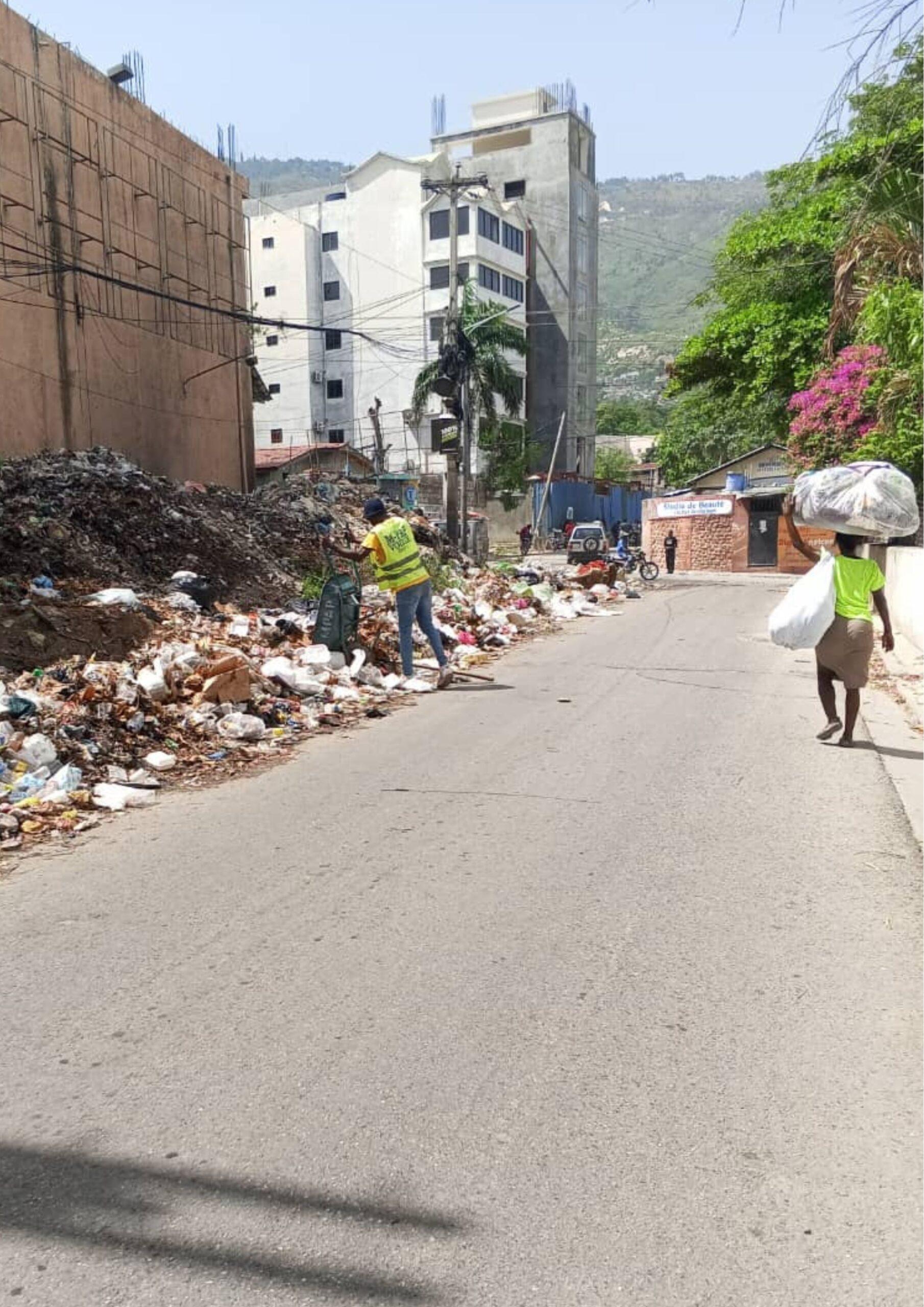
An employee of the Port-au-Prince mulicipality throws trash next to the Tag Market premises in Canapé-Vert. Photo taken by Fenel Pélissier on August 5, 2025.
A former mayor of Cité Soleil revealed to AyiboPost that armed gangs are now setting up toll booths on the Carrefour Duvivier road leading to Truitier.
« All trucks using this road have to pay to pass, » he said, without being able to specify the amounts charged.
The Cité Soleil town hall, however, is exempt from these illegal payments.
« Our municipality does not pay anything to the gangs to dump their trucks in Truitier, » confirms Luckson Michel, director of the town hall, saying he does not know the amounts paid by the other drivers.
However, he points out, waste management remains a colossal challenge, especially since Cité Soleil also receives waste from other municipalities.
« For the volume of waste we receive, the municipality is not equipped to collect it all, » laments the director.
Our municipality does not pay anything to the gangs to dump their trucks in Truitier
-Luckson Michel
The town hall has three compactor trucks (two of which are working), a dump truck that frequently breaks down and a backhoe loader.
Contacted by AyiboPost, Francky Roland, head of the Truitier site, confirmed that the landfill remains operational.
« Our work is strictly technical. We have no direct relations with the companies, public or private, that dump their waste on the site. If they are in contact with [the gangs] outside, we are not informed, » he explains.
Faced with these obstacles, the Pétion-Ville city council turned to the town of Titanyen. To reach it, its trucks took the Canaan road, an area under the control of the Viv Ansanm coalition.
« As a precautionary measure, we do not send our drivers when there are armed clashes in these areas, » explains Staco Amazan, deputy mayor of Pétion-Ville.
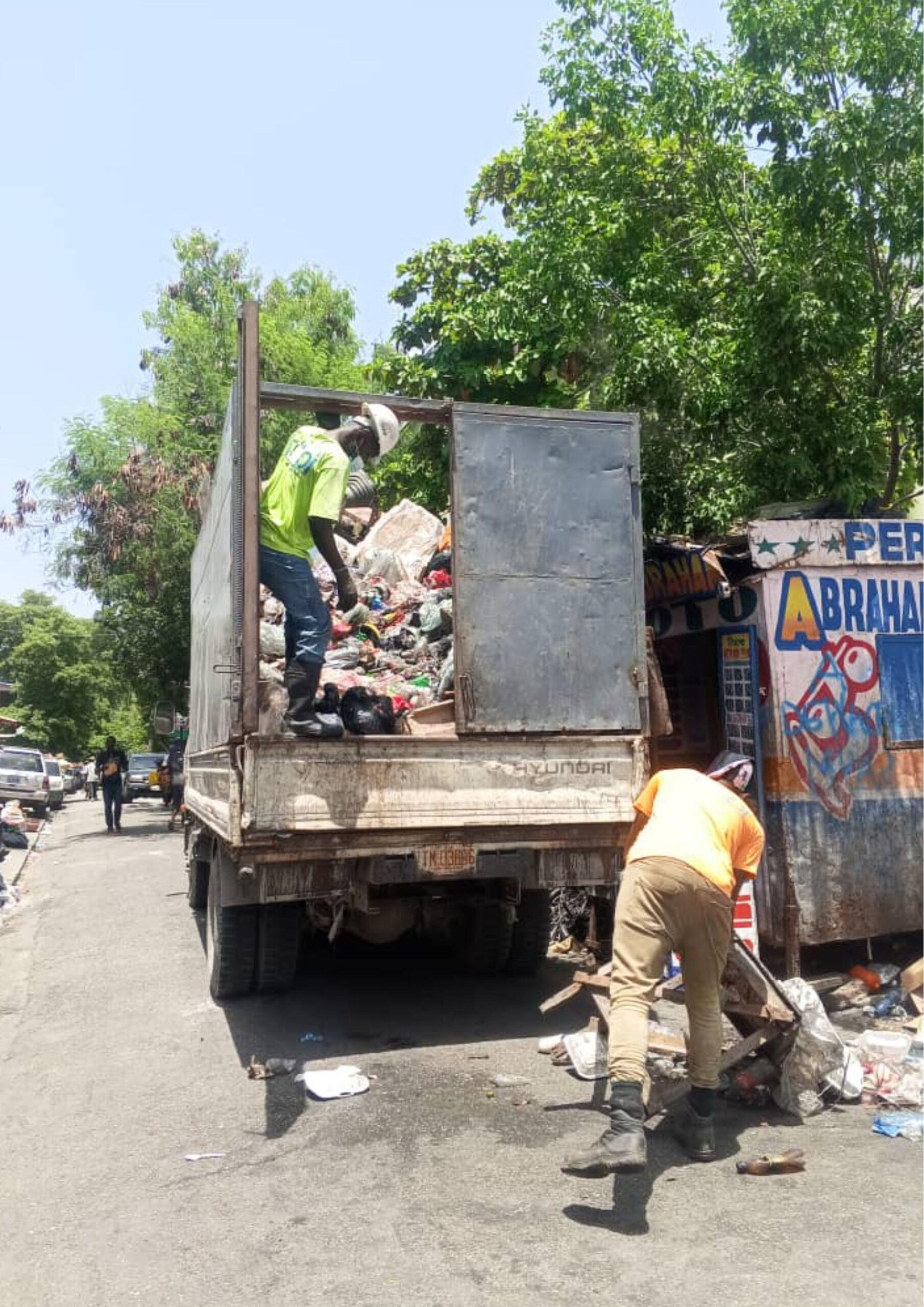
A man collects rubbish near the Ministry of Communications in Bois-Verna. Photo taken on August 22 by Fenel Pélissier
Other sites previously used by the municipality, including Laboule 12 and Eddy One in Tabarre, are now in the hands of gangs.
A decision by the Ministry of the Interior and Local Authorities in August 2024 prohibited the Pétion-Ville town hall from using the Laboule 12 illegal dump, one of the few sites still accessible.
This measure aimed to protect the health of local residents and preserve the water table, which is unique in the region.
According to Amazan, the situation today makes waste collection and management extremely complicated in the municipality, which also hosts thousands of displaced people driven from other areas by violence.
“Pétion-Ville has never generated such a quantity of waste before,” he emphasizes.
With only three dump trucks and three compactor trucks operational, the task remains arduous.
« Our trucks can carry seven tons and up to eighteen cubic meters of garbage, but our drivers can only make two trips a day at most, due to the distance to the dump sites, » adds the elected official.
« If we could increase our fleet – for example, have ten trucks – it would allow us to make twenty trips per day, two per truck. The CNE used to help us, but this institution is now demobilized, » continues Staco Amazan.
For its part, the municipality of Port-au-Prince is creating temporary dumping areas in uninhabited areas of several neighborhoods, says Guerslyn Charles.
According to him, around ten temporary sites have been set up in districts such as Canapé-Vert and Bourdon, « while waiting to be able to transfer them to appropriate treatment locations. »
Long before the arrival of the displaced, Port-au-Prince was already facing enormous difficulties in managing its waste.
Today, the situation is critical: the town hall only has one compactor truck and one dump truck.
The CNE used to help us, but this institution is now demobilized
– Staco Amazan
The displacement camps produce a mass of waste that far exceeds municipal capacity.
According to Guerslyn Charles, management costs are very high: fuel, spare parts, maintenance, and regular oil changes. « And the town hall has no financial income, » he insists.
In many neighborhoods, unsanitary conditions are increasing. Individuals are transporting waste themselves and dumping it in ravines.
The problem goes beyond Port-au-Prince.
According to the World Bank (2018), Haiti generates approximately 6,380 tons of waste per day. The capital is the main producer.
Only 12% of urban solid waste is collected, and the contribution of public services remains very low.
In 2015, the Ministry of Public Works, Transport and Communications (MTPTC) estimated Port-au-Prince’s production at 900,000 tonnes per year, of which only 25% was sent to landfill sites.
The cost of treatment was then estimated at 710 gourdes per tonne.
The United Nations Development Programme (UNDP), in a study entitled Solid Waste Management in Haiti: An Exploratory Analysis, highlights that Haiti does not have properly equipped landfills.
Most sites are open dumps, where waste is burned on site.
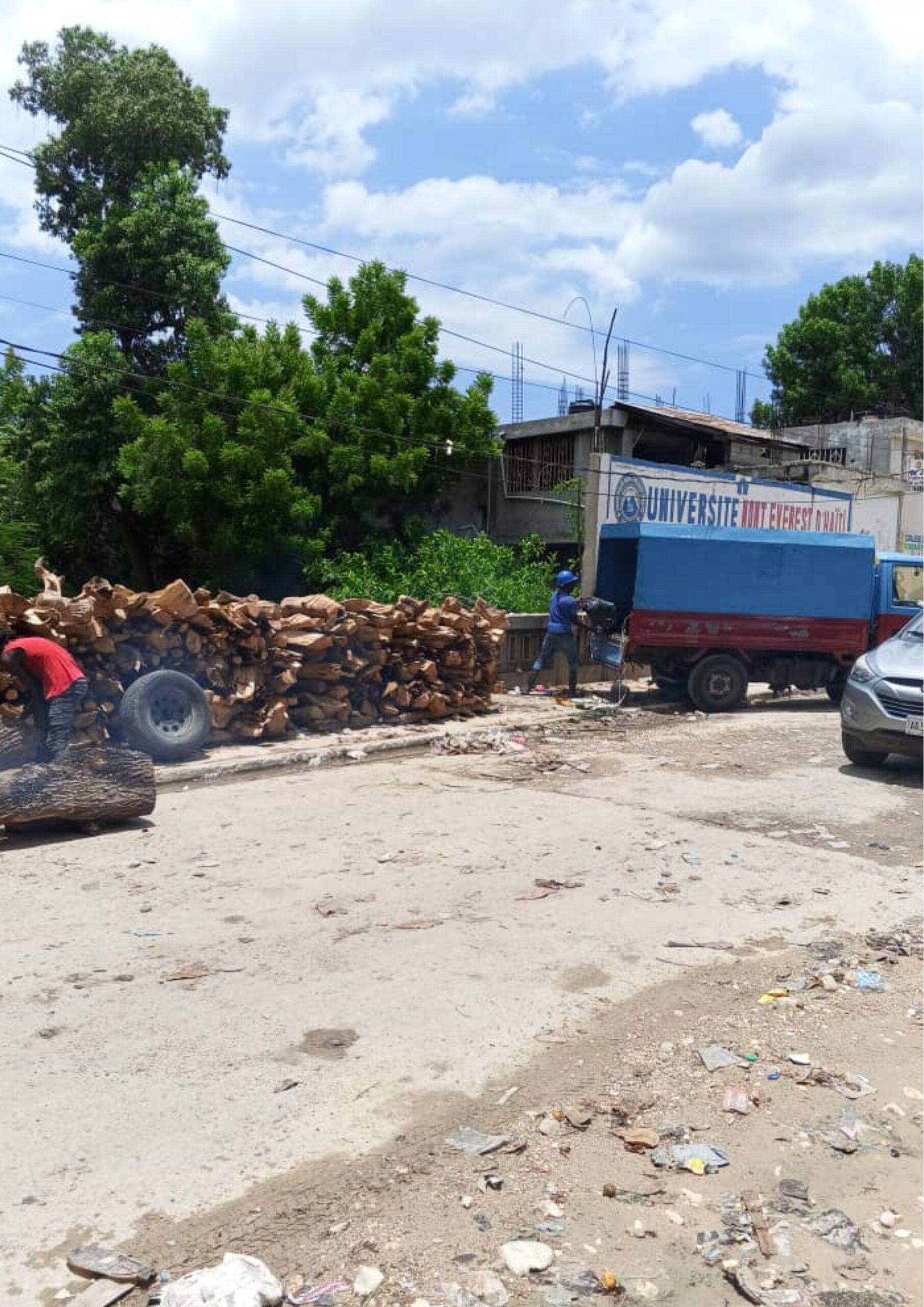
A man takes trashes out of a truck and dumps it in a ravine on Rue Camille Léon in Turgeau. Photo taken by Fenel Pélissier on August 3, 2025.
A law adopted in September 2017 created the National Solid Waste Management Service (SNGRS), replacing the Metropolitan Solid Waste Collection Service (SMCRS), whose operations were limited to Port-au-Prince.
Placed under the supervision of the Ministry of the Environment, this new institution is responsible for the collection, transport, sorting, recycling and transformation of waste on a national scale, as well as setting standards and applying sanctions.
But according to the SNGRS executive already cited, the institution suffers from a glaring lack of material and financial resources.
« The little equipment we have is worn out or in poor condition due to lack of maintenance. More than 70% of the budget is spent on salaries. Even the Delmas town hall’s fleet is better equipped than that of the SNGRS, » he emphasizes.
Former mayor Jude Édouard Pierre confirms: « The SMCRS was unable to deliver results at the metropolitan level. Its scope of responsibility was expanded to the national level without increasing human, financial, and material resources. »
According to the World Bank (2018), Haiti generates approximately 6,380 tons of waste per day. The capital is the main producer.
« Despite its fleet of vehicles, Carrefour town hall was unable to manage its waste. So what about the SNGRS, which has no resources and a national mission, » he concludes.
However, with an adapted strategy and targeted investments, Haitian waste could become an export resource.
In 2018, the country exported $3.35 million worth of metal and plastic waste, according to the Bank of the Republic of Haiti (BRH).
Par : Fenel Pélissier
Cover | A garbage truck unloading trash.
► AyiboPost is dedicated to providing accurate information. If you notice any mistake or error, please inform us at the following address : hey@ayibopost.com
Keep in touch with AyiboPost via:
► Our channel Telegram : Click here
►Notre Channel WhatsApp : Click here
►Our Community WhatsApp : Click here






Comments