
André ‘Andy’ Apaid, owner of Premium Apparel S.A., was sanctioned by Canada in 2023
Consulter cet article en français
Nearly a thousand workers from the Premium Apparel S.A. factory, owned by businessman André “Andy” Apaid, are demanding their full compensation following the “sudden” closure of the factory in 2023, after the termination of its contract with the Canadian company Gildan.
This dispute, which is still awaiting a decision from Haiti’s Labor Directorate, leaves these workers without any guarantee of payment, according to union leaders, workers, and lawyers involved in the case who spoke to AyiboPost.
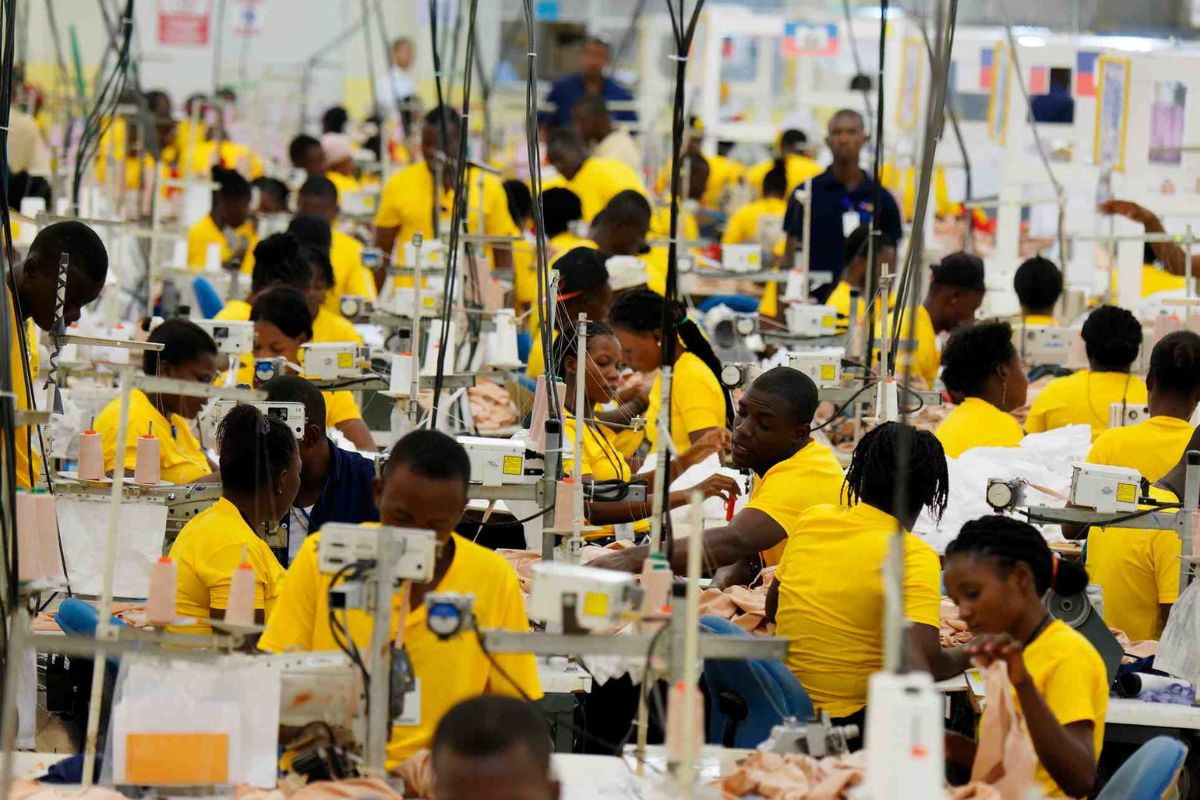
Overview of a textile factory in full swing, where dozens of workers are busy operating industrial sewing machines. Better Work Haiti
The subcontracting textile factory Premium Apparel S.A. shut down “unexpectedly” on November 3, 2023, union representatives say.
While the exact reasons for the closure have not been fully clarified, it came after the termination of a contract between the factory and Gildan, one of Canada’s most highly regarded clothing manufacturers.
This decision came nearly five months after the Canadian government sanctioned businessman and former supplier to the U.S. Department of Defense, André “Andy” Apaid, in June 2023, for “serious human rights violations.”
A source within Better Work Haiti—a program of the International Labour Organization (ILO) aimed at improving working conditions in Haiti’s textile industry—confirmed that the sanctions were “one of the main reasons” that led Gildan to end its collaboration with Apaid.
As soon as the Canadian sanctions were announced in June 2023, Gildan informed Better Work Haiti— which works with the various actors in Haiti’s textile sector—as well as Premium Apparel S.A., by letter, of its decision to suspend the contract, specifying the timeline for its implementation, according to a source familiar with the procedures.
In an email response provided to AyiboPost, Better Work stated that “Gildan paid the full severance benefits [vacation, maternity leave, and bonuses] not covered by Premium Apparel.”
The Canadian contractor took this initiative while Premium Apparel’s management claimed it “did not have the money,” according to the Better Work source familiar with the case.
This operation was carried out after validation by the Ministry of Social Affairs and Labor (MAST), Better Work, labor unions, the U.S. Department of Labor (USDOL), and other relevant institutions.
The email shared by Better Work with AyiboPost states that “each eligible worker received the compensation owed to them, in accordance with these validated calculations.”
The subcontracting textile factory Premium Apparel S.A. shut down “unexpectedly” on November 3, 2023, union representatives say.
However, workers dispute the calculation methods, and some say they received no compensation at all.
According to Henry Délices, a union leader with the Entè Sendikal 1e Me Batay Ouvriye coalition, although 930 factory workers did receive statutory benefits, numerous irregularities remain.
Among those who were paid, some received incomplete amounts; certain higher-level workers at the factory, as well as one worker, did not receive their legally mandated benefits, Délices says.
A group of 68 workers, also involved in this case, were laid off in June 2023 without notice, while they were demanding payment of their contributions to ONA and OFATMA, which had not been paid by the Premium Apparel factory, Délices reports.
Although they received legal benefits, the amounts were incomplete, the union representative notes.
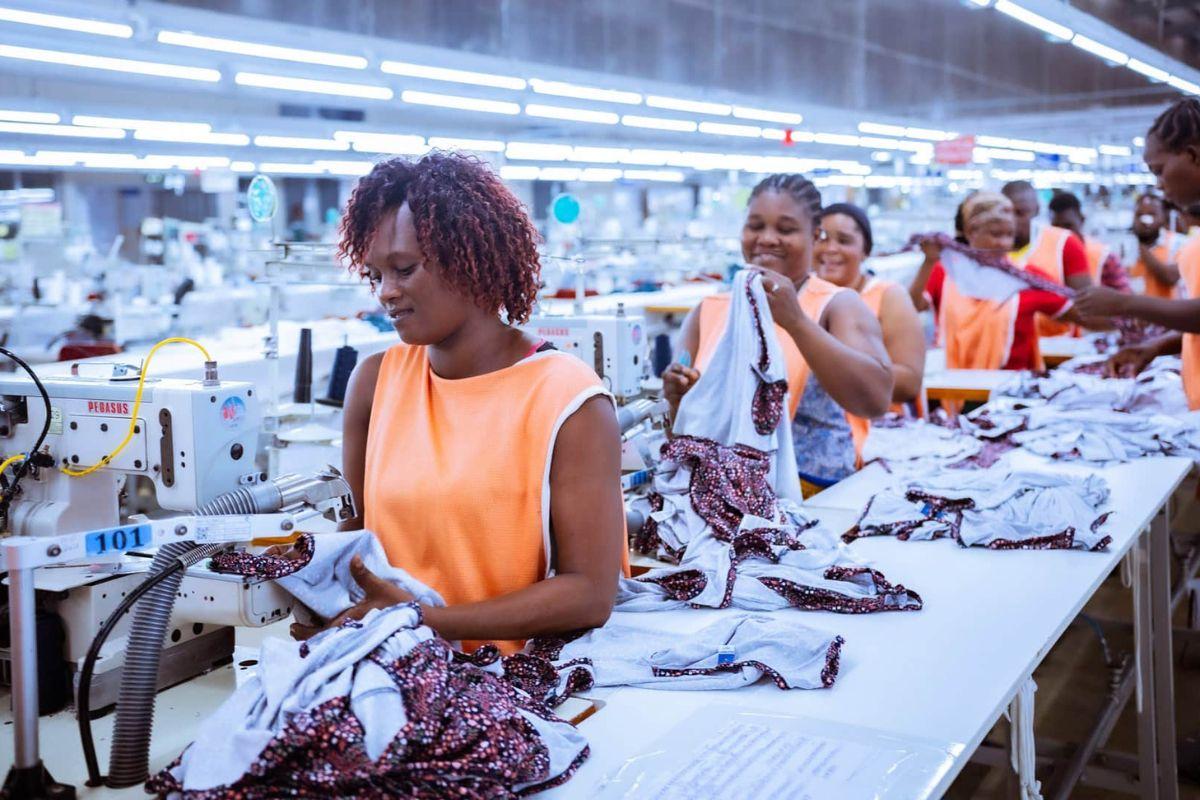
A worker handles a patterned fabric garment on a sewing machine along a production line in an industrial textile workshop.
In Haiti, Articles 490 and 491 of the Labor Code provide that in the event of a company closure and failure to guarantee workers’ wages and related benefits, the Labor Court, at the request of the Labor Directorate, may issue an order preventing the removal of furniture and real estate assets belonging to the company until the situation is resolved.
Premium Apparel S.A. was contacted by AyiboPost via email. The company did not respond to requests for comment.
Canada’s Special Economic Measures Regulations targeting Haiti (in response to gang violence and its supporters) impose an asset freeze on any individual listed under the official sanctions regime.
It is prohibited for any person in Canada and for any Canadian abroad to conduct transactions involving the property of a listed person; to enter into or facilitate transactions related to such property; to provide financial or related services for those transactions; to make goods available to a listed person (or someone acting on their behalf); or to provide financial or related services to or for the benefit of a listed person.
“Because Gildan is a Canadian company, it could not continue working with an organization listed under sanctions. It therefore had no choice,” the Better Work Haiti source said regarding the suspension of Gildan’s contract.
Télémaque Pierre, a member of the Sendika Ouvriye Tekstil ak Abiman (SOTA), believes that “the closure of the company occurred because Apaid was constantly violating workers’ rights.”
The union leader refers to warnings from Gildan concerning a potential contract termination due to non-compliance with its terms, including delayed deliveries, failure to meet production deadlines, and violations of workers’ rights and dignity.
Although no formal threat was issued, the source within Better Work Haiti said there were “concerns” related to zero-tolerance criteria included in certain brands’ codes of conduct, particularly regarding contributions to the National Old-Age Insurance Office (ONA) and the Office for Occupational Accident, Sickness and Maternity Insurance (OFATMA), working conditions, and freedom of association.
Before publication, AyiboPost contacted Canadian apparel manufacturer Gildan. The company did not respond to requests for comment.
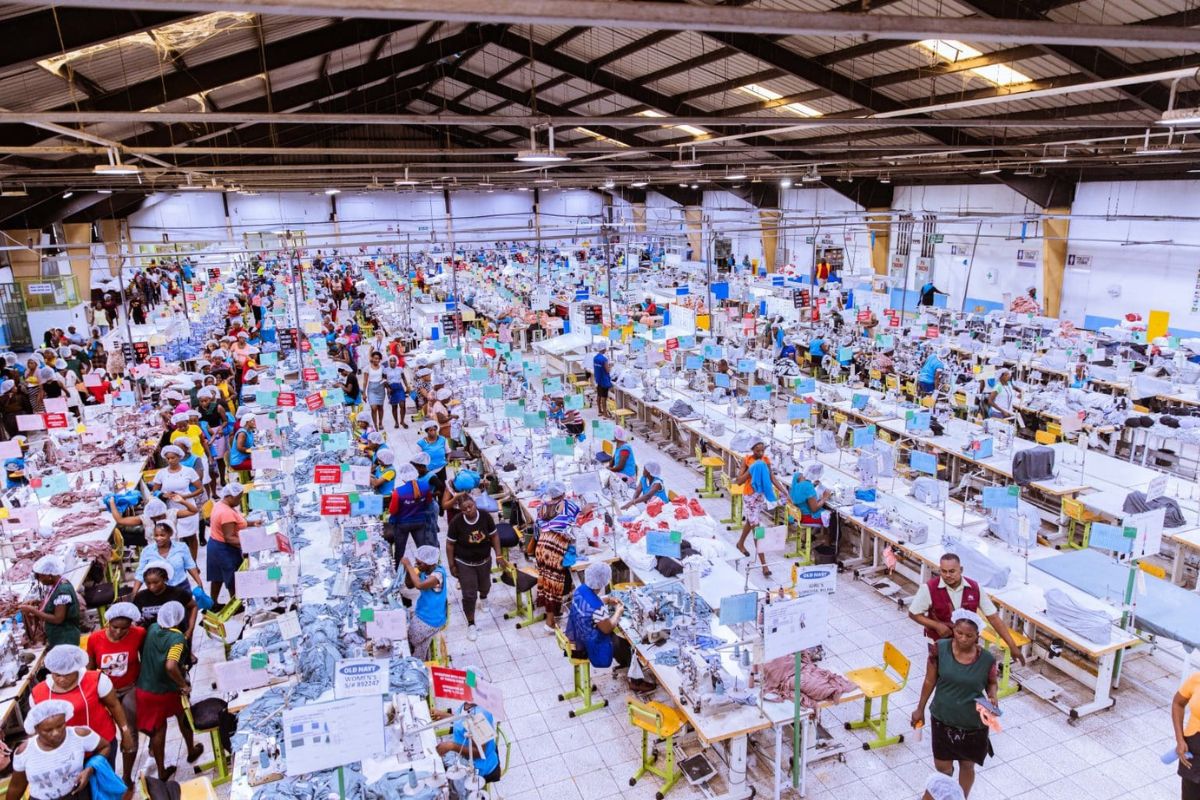
Bird’s-eye view of a textile production hall, where hundreds of employees line up along rows of machines under the metal structure of an industrial warehouse.
*
Bety Pierre, 38, had lived in Solino since 2019 but was forced to flee in October 2024 to take refuge in Bon-Repos, in the commune of Croix-des-Bouquets, an area controlled by the violent gang “400 Mawozo.”
Her seven years as a worker at Premium Apparel S.A. were marked by numerous upheavals.
“I was fired once without notice, then reinstated until the factory closed in 2023,” Pierre told AyiboPost.
Since the closure, she has joined workers protesting the lack of full compensation. She says a supervisor told them they would receive their “payment” eight days later. But, “in concrete terms, nothing has happened yet.”
For Pierre, the factory’s closure came at the worst possible time. “It’s the worst moment of my life,” she says, “because I was doing nothing else but this job.”
*
Better Work Haiti also points to long-standing arrears in Premium Apparel’s social security contributions, notably “pension contributions not paid to the National Pension Insurance Office (ONA).”
While the total amount of these unpaid contributions remains unknown, an AyiboPost investigation published in 2023 confirmed similar practices by several subcontracting employers, including Premium Apparel S.A., who withheld deductions from workers’ wages without transferring them to the state, in violation of the law.
At the time of the factory’s closure in 2023, “a set of social contributions deducted from workers’ wages were not deposited either with the ONA or with the Office for Occupational Accident, Sickness and Maternity Insurance (OFATMA),” Télémaque Pierre also alleges. He was dismissed in 2018 after demanding proof that these same contributions had been paid, according to his account.
That same year saw a wave of layoffs, which had begun as early as 2012, along with staff reductions.
In total, around fifty workers—including union activists—were dismissed in 2018, but only about thirty were later reinstated, Pierre says.
Thirty-five-year-old Carolis Marc Dala is a seamstress who worked at Premium Apparel, where she added necklines to T-shirts from 2015 until the factory closed, working Monday through Saturday.
A mother of four, she describes her experience at Premium Apparel as deeply unremarkable.
“I didn’t want to stay idle,” she explains. “So I took this job, even though it didn’t meet my needs.”
Since the factory’s closure, she says she has been unemployed and entirely dependent on her husband’s income to feed her family.
She says she was promised compensation of 15,000 gourdes, which never materialized. “If I had received that money, I would have invested it in a small business.”
*
Following the closure of Premium Apparel, workers initiated a series of démarches with state authorities, which have so far proven unsuccessful.
“In this case, we notified the labor director, Guerline Jean-Louis, by letter, but she did nothing,” says attorney Evel Fanfan, legal counsel for the dismissed workers.
The letter, sent in November 2023, demanded oversight of all legally mandated benefits owed to workers (notice pay, bonuses, paid leave, arrears, final wages, maternity leave, work-related accidents and illness), as well as an inventory of the company’s movable assets.
The Fanfan law firm also urged the Labor Directorate to apply the provisions set out in Articles 490 and 491 of the Labor Code.
Renewed up to four times without success, this correspondence was followed by a formal legal notice against former labor director Guerline Jean-Louis for “abuse and excess of power,” Fanfan says, also without result.
This subsequently led to the referral of the case to the criminal court, according to attorney Evel Fanfan.
The case was reintroduced at the Labor Directorate in January 2026. It is still awaiting transmission to the Labor Court.
For Fanfan, “the Haitian state, which is supposed to guarantee workers’ rights, appears to be the main violator of those rights.”
AyiboPost contacted the Labor Directorate through the Ministry of Social Affairs. An update will be published if a response is received.
For now, Premium Apparel workers—“whose rights were systematically violated,” according to Fanfan—are still waiting for their statutory benefits and compensation, as provided for under Article 49 of the Labor Code.
This situation has led the lawyer to consider bringing the case before international bodies “so that these violations do not go unpunished,” he said.
*
Union leader Henry Délices, a former Premium Apparel worker, describes six “difficult” years spent at the factory.
“Even when you’re a skilled professional, you’re treated like a slave,” says Délices, who has been active in the sector since 2008.
He describes situations in which sewing machine operators were unable to move to attend to basic physiological needs or to leave work until they had met clothing production quotas—even when delays were beyond their control.
“When we demand accountability from management, we get fired,” Délices says, also criticizing the state’s lack of support during labor protests.
Dismissed in 2022, he claims he was fired after demanding that the company cover funeral expenses for a colleague who was killed by gunfire from armed gangs at the factory site.
“At the time of my dismissal, I received neither my statutory benefits nor damages,” Délices maintains.
Evaluations conducted by Better Work Haiti at Premium Apparel in November 2022 reveal multiple violations of both national and international labor standards, particularly regarding respect for workers’ fundamental rights.
Among the findings, eligible female workers received only six weeks of paid maternity leave, despite Haitian law mandating twelve.
The report also notes the absence of proof that payroll records were transmitted to OFATMA for the payment of maternity and sickness benefits.
Although all contributions owed to the ONA were eventually transferred, the report emphasizes that they were paid late.
Premium Apparel, which employed more than 2,000 workers around 2016, saw its workforce begin to decline in 2017, falling to around 1,000 employees by the time it closed in 2023.
In Haiti, the textile sector—which accounts for 90 percent of national exports—faces major economic challenges, including declining demand and intensified global competition. These pressures have been compounded by factory closures and job losses.
In 2022, out of approximately one billion dollars in exports to the United States—a key market for Haiti—836 million came from the textile and apparel sector, according to the U.S. Department of Commerce’s Office of Textiles and Apparel (OTEXA).
Overall, Haitian textile exports to the U.S. market have experienced a sharp decline over the past decade.
According to U.S. government data cited by Better Work Haiti, annual exports in 2024 fell below 600 million dollars, down from 824 million dollars in 2023—a 28 percent drop in export revenues.
Employment in the industry has also declined.
In March 2024, 35,419 people were employed in Haiti’s textile sector. By May, that number had fallen to 33,857, according to Better Work Haiti data. The decline continued in June, with employment dropping to 32,293—representing a loss of 3,126 jobs in less than three months. By November of the same year, the number of textile workers had fallen to 26,500.
These income losses and job cuts have deeply affected communities that depend on factory employment.
The country’s unstable sociopolitical context, combined with gang control over much of the Port-au-Prince metropolitan area, has forced factories to interrupt or cease operations.
At the beginning of 2024, Better Work Haiti recorded 29 factories. By December 2024, only 22 remained operational, with the others having permanently shut down.
The closure of seaports and the suspension of U.S. flights to the country’s main airport in April and November 2024 disrupted the transport of raw materials and finished goods.
On January 12, 2026, the U.S. House of Representatives adopted a resolution extending the program (HELP Extension Act) for an additional three years. The bill was then transmitted to the U.S. Senate for final adoption, before being sent to President Donald Trump, who must sign it for it to enter into force.
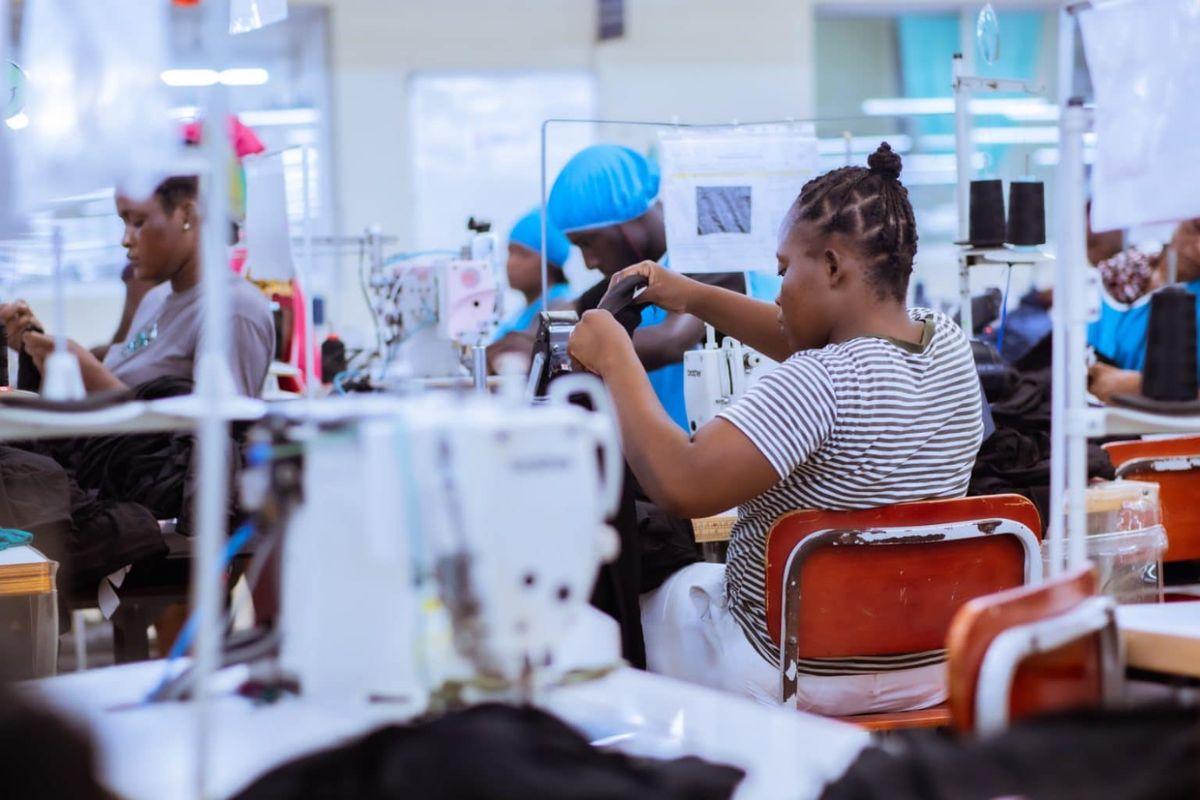
Cover | View from behind, an employee assembles garments in a textile factory. Photo : Better Work Haïti
► AyiboPost is dedicated to providing accurate information. If you notice any mistake or error, please inform us at the following address : hey@ayibopost.com
Keep in touch with AyiboPost via:
► Our channel Telegram : Click here
►Notre Channel WhatsApp : Click here
►Our Community WhatsApp : Click here





Comments