
Since the adoption of a new migration protocol in April 2025, Dominican authorities have been tracking pregnant Haitian women even in hospitals, according to three sources familiar with the matter, contacted by AyiboPost
Ronald Jean experienced the worst tragedy of his life in May 2025, in the province of El Seibo, Dominican Republic, when his wife, Lourdia Jean Pierre, died in his arms at home, minutes after giving birth to their fourth child.
Fearing arrest and deportation to Haiti by Dominican authorities, the 33-year-old businesswoman was forced to give birth at home, without the assistance of a healthcare professional.
« She had a difficult delivery, exhausted and at the end of her strength, before dying shortly afterwards, » testifies Ronald Jean. The couple fled the violence in Haiti in 2021.
“I am devastated. The sudden death of my wife has deeply shocked me,” the man told AyiboPost, adding that the paramedics were unable to arrive in time.

Arrival of Haitian immigrants repatriated by the Dominican Republic at the border of Ouanaminthe. (Ouanaminthe, Haiti, October 21, 2025) Photo: Pierre Michel
The newborn was taken to the hospital to receive the necessary care, and Lourdia Jean Pierre was buried the same day in the local cemetery of Seibo, in the municipal district of Pedro Sánchez.
« Many pregnant women who witnessed how Lourdia died have left the Dominican Republic to return to Haiti, for fear of suffering the same fate, » explains Ronald Jean.
Last August, the Support Group for Repatriates and Refugees (GARR) had denounced the death of Natacha Désir, 35, and that of her baby, which occurred a few hours after her delivery at the Verón Municipal Hospital.
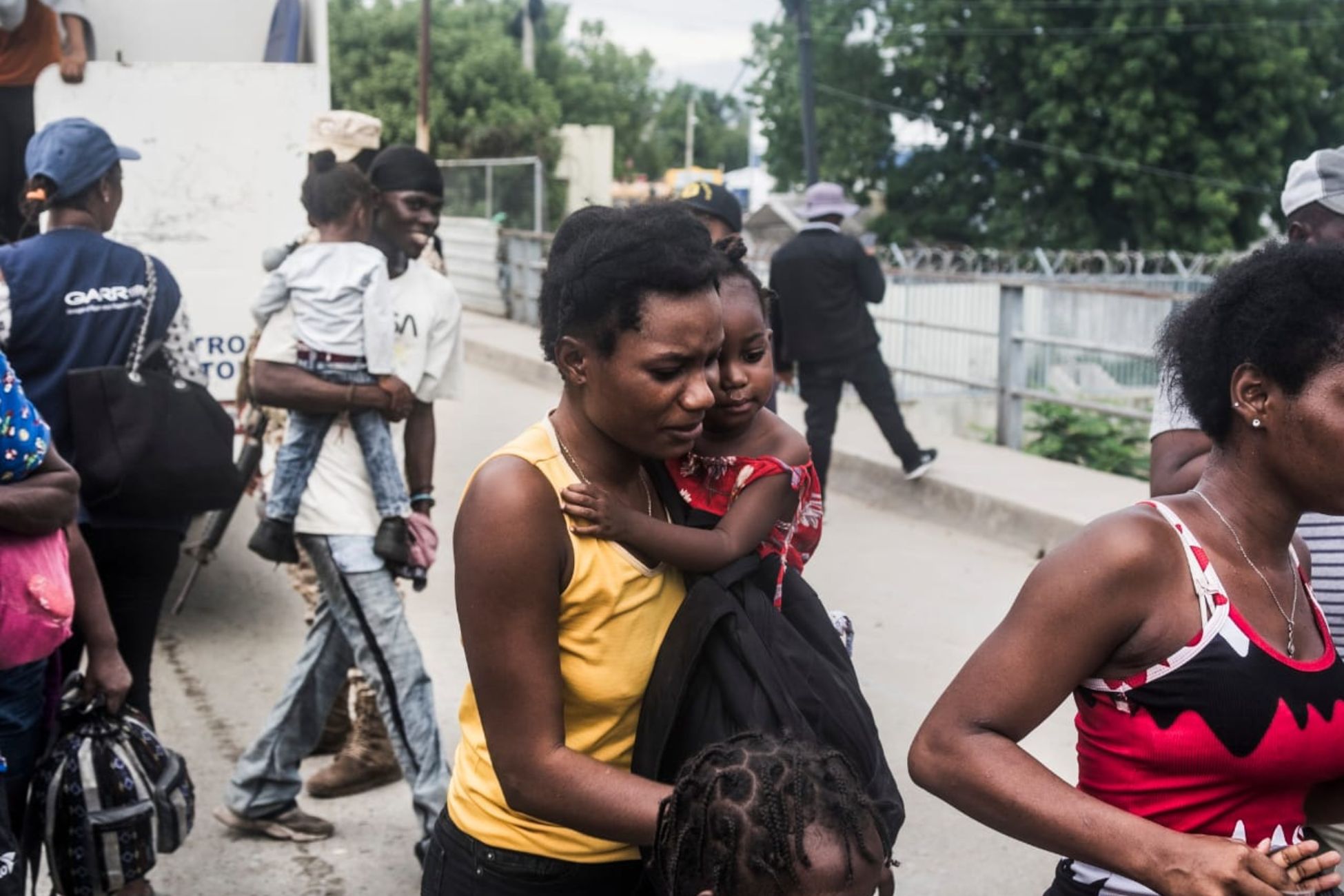
Arrival of Haitian immigrants repatriated by the Dominican Republic at the border of Ouanaminthe. (Ouanaminthe, Haiti, October 21, 2025) Photo: Pierre Michel
Désir’s family, who were present at the hospital at the time of the incident, believe that the mother and child died as a result of negligence by medical staff, reports GARR.
These deaths come amid a tightening of migration measures by the Dominican Republic targeting Haitian migrants.
Dominican President Luis Abinader has, in fact, made Haitian immigration one of his main priorities since coming to power in 2020.
Dominican nationalists who supported his candidacy fear that the influx of Haitians will irrevocably alter the demographic, cultural and linguistic character of the country, particularly in border areas.
One of the most recent measures by the Dominican administration was announced in April 2025, when the government put in place a new fifteen-point immigration protocol, applied in 33 hospitals in the country’s public network.
Among these measures, foreign patients must present a valid identity document, proof of employment and proof of residence.
Otherwise, they can only receive emergency care and, once their condition has stabilized, are reported to immigration services for possible repatriation.
Thousands of Haitians who work in Dominican companies or in the fields do not have these official documents.
Since the adoption of this new migration protocol, Dominican authorities have been tracking pregnant Haitian women even in hospitals, according to three sources familiar with these facts, contacted by AyiboPost.
Many prefer to stay at home, despite their pregnancy and need for medical care.
Three Haitian women who immigrated to a neighboring territory told AyiboPost about the difficult conditions in which they had to give birth in the Dominican Republic. They wish to remain anonymous for security reasons.
One of them, a 25-year-old shopkeeper, recounts having lived through this experience in August 2025. While she was about to give birth, she had great difficulty getting to a public hospital: her neighbors had warned her that she risked being arrested by Dominican immigration services.
“I had to change my plans and pay 25,000 pesos — or about 52,000 gourdes — in a private clinic for a cesarean delivery, whereas it would have been free in a public hospital,” she testifies.
The young woman had gone to the Dominican Republic in 2023 for her vacation. It was there that she learned that bandits had invaded her house located in Delmas 24.
Before the United Nations General Assembly in 2024, Dominican President Luis Abinader stated that nearly 10 % services provided by the Dominican health system had been intended for Haitian migrants in 2023.
In a report published on November 17, 2025, Amnesty International challenges the official rhetoric that Haitian migrants are saturating the Dominican health system.
According to the international organization, « the structural problems related to access to public health are not due to the demand for health services from Haitians living in the country, but rather to insufficient funding and limited availability of resources. »
The human rights organization also points out that, according to the World Health Organization (WHO), the Dominican Republic ranks second among countries in the region with the lowest public health spending as a proportion of GDP. The country allocates only 2.7% to healthcare, less than half of the 6% recommended by the WHO.
According to the Amnesty International report, Haitian people accounted for only 7.9% of total consultations and 14.8% of total hospitalizations.
In the provinces of Elías Piña, Pedernales and El Seibo, where the number of consultations was higher, the total number of patients represented only 2% of the country in 2025.
“The new protocol violates the rights to health, equality and non-discrimination guaranteed by the International Covenant on Economic, Social and Cultural Rights, as well as by the International Convention on the Elimination of All Forms of Racial Discrimination (CERD),” notes Amnesty International.
The Dominican government did not respond to a request for comment from AyiboPost before this article was published.
In recent years, Dominican civil society organizations have denounced the detention conditions of Haitian migrants, in a context of mass deportations amplified since 2024 by the administration in place.
Read also: Brutality and repression: the ordeal of Haitian migrants expelled from the Dominican Republic
In a joint statement published on November 20, seven human rights organizations reported the death of a newborn at the Haina detention center.
According to the document, Haitian Melissa Jean Baptiste and her baby were placed in this center a few hours after giving birth at the Nuestra Señora de Regla hospital in Baní, in the province of Peravia.
The newborn died in the early morning of November 14th.
For years, Haina has frequently been at the center of criticism regarding the treatment of detainees by Dominican authorities.
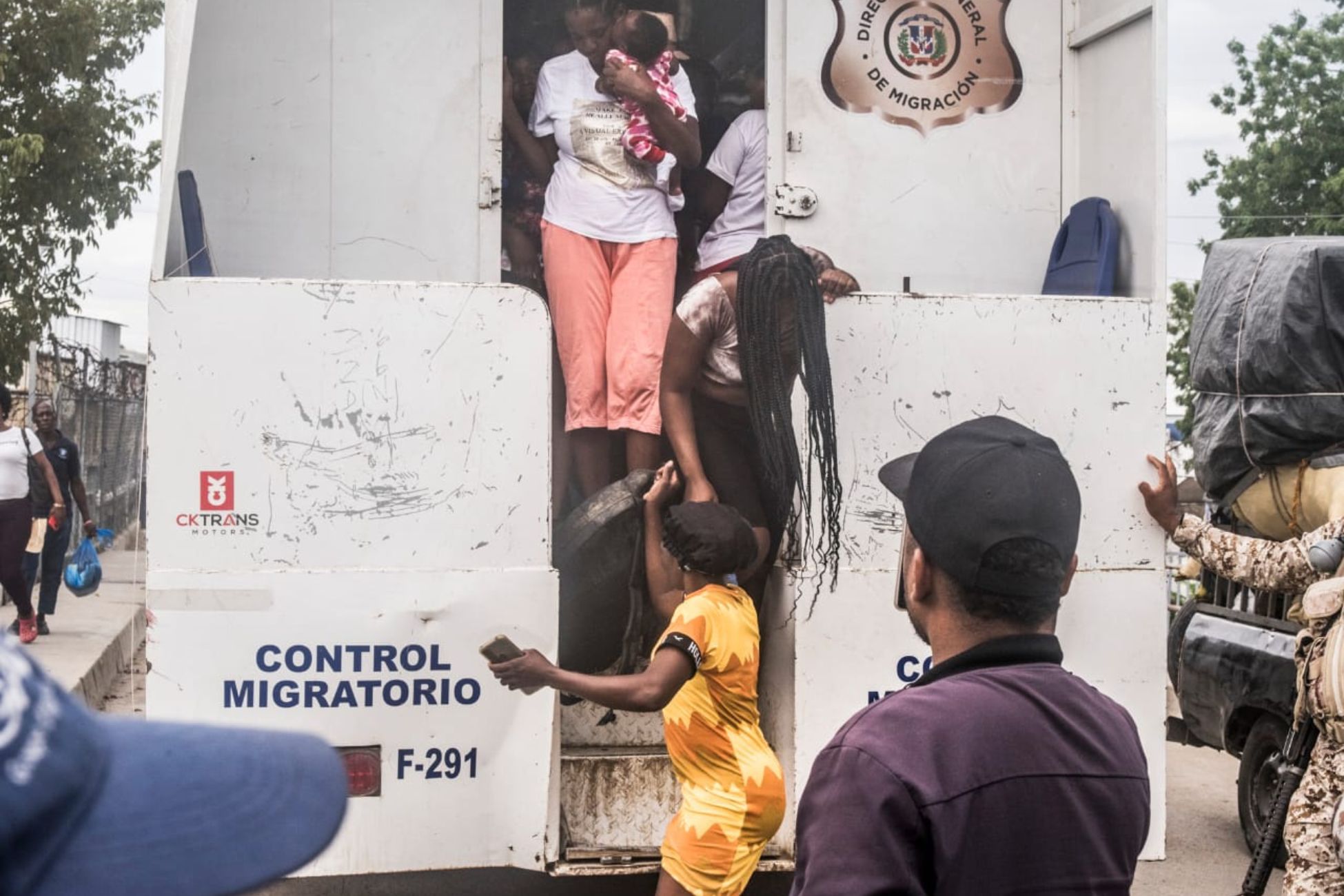
Arrival of Haitian immigrants repatriated by the Dominican Republic at the border of Ouanaminthe. (Ouanaminthe, Haiti, October 21, 2025) Photo: Pierre Michel
The general law 285-04 on migration explicitly and categorically prohibits the administrative detention of minors and breastfeeding women.
Since the beginning of 2025, authorities have acknowledged the deaths of three people held in this center.
The HaitianosRD collective, for its part, documents the deaths of 54 people of Haitian origin in the context of the mass expulsions that occurred between 2021 and mid-2025.
Because of their status as undocumented migrants, some women resort to a third party with legal status to have their babies vaccinated in public hospitals.
For her baby’s first doses of vaccine, one of the three women contacted by AyiboPost explained that she paid 1,500 pesos — more than 3,000 gourdes — to a person with legal status to take the child to a public hospital in Santo Domingo.
Read also: Haina, the hell of Haitian migrants in the Dominican Republic
Interviewed by AyiboPost, Monica Osias Ramírez, a psychologist and doctor, confirms the existence of this practice in Haitian communities to escape the controls of the Dominican authorities.
The psychologist works at the Dr. Vinicio Calventi General Hospital in Santo Domingo.
“I was in contact with a Haitian woman who had given birth at home. She couldn’t take her baby to be vaccinated. I had to ask someone with legal status to take the baby in her place,” she told AyiboPost.
According to the psychologist, many Haitian women who gave birth at home also experience difficulties in registering their children with the civil registry.
The professional says she knows more than a dozen women in this situation.
Births to Dominican and foreign mothers in centers of the public hospital network are recorded only in a register of births and deliveries kept by the hospital itself, where they are clearly classified according to the nationality of the mother.
Subsequently, and using this book of births and deliveries as the main source, hospital health personnel fill out the birth certificate, with the corresponding color: white if the mother presents documentation proving her Dominican nationality, and pink if the mother is foreign, non-resident (without distinction of country), in accordance with the mandate of point 1, article 28, of the general migration law 285-04.
According to Mónica Osias Ramírez, the number of births among Haitian women has declined significantly since the implementation of the anti-migrant policy in Dominican Republic hospitals.
In June 2025, the National Health Service (SNS) reported that the care provided to Haitian citizens in public hospitals had fallen by nearly 67% since the entry into force of the migration protocol.
Of the 7,900 births recorded in January, 38% were to Haitian women, while in May, of nearly 5,000 births, this proportion fell to only 17%.
The number of consultations for Haitian citizens fell from 44,000 in January to 14,000 in May of this year, a decrease of 67%.
Emergency room visits decreased from 41,000 to 13,000, a drop of 66%, and surgical procedures declined by 56% over the same period.
In 2012, the Dominican Republic’s highest court has ruled that “children born in the country to foreign parents” since 1929 would be stripped of their Dominican nationality.
In September 2013, Constitutional Court ruling 168-13 imposed on persons born in the Dominican Republic after 1929, to foreign parents, the obligation to prove the regular immigration status of their parents in order to retain Dominican nationality.
This court decision only applied to people of Haitian origin.
A period of one year had been planned to allow those concerned to regularize their status.
To obtain their regularization, they had to provide a series of documents often beyond their reach.

Arrival of Haitian immigrants repatriated by the Dominican Republic at the border of Ouanaminthe. (Ouanaminthe, Haiti, October 21, 2025) Photo: Pierre Michel
Even today, the migratory status of these people of Haitian descent remains precarious.
Since the protocol of April 21 came into effect, the already fragile situation of undocumented Haitian nationals has worsened.
“People have stayed home. Those suffering from chronic illnesses, such as hypertension or diabetes, no longer set foot in hospitals. Sometimes, they have gone to live in very remote areas to avoid being detected,” Epifania St Chals, a Haitian migrant rights activist told AyiboPost.
Some undocumented migrants sometimes opt for private clinics, which, according to the activist, represents a heavy financial burden for families.
Indeed, the price of a cesarean section can go up to 23,000 pesos — or 50,000 gourdes — and a consultation can cost more than 2,000 pesos — or 4,000 gourdes — in private health facilities.
According to the activist, Haitian mothers sometimes pay doctors in collusion with immigration officials to obtain permission to leave the hospital.
“A week ago, a woman about to give birth in a public hospital paid 50,000 pesos — about 110,000 gourdes — to a doctor to help her escape immigration officers. By the evening, she had given birth and left the hospital with her baby,” St Chals told AyiboPost.
The activist also notes cases where Haitian mothers abandon their newborns in the hospital after giving birth to escape immigration. His organization has already recorded at least three such cases between August and September 2025.
AyiboPost was unable to obtain comments from the Haitian government prior to the publication of this article.
By : Fenel Pélissier
Cover : Midsection of pregnant woman touching abdomen against white background. Photo : Freepik
► AyiboPost is dedicated to providing accurate information. If you notice any mistake or error, please inform us at the following address : hey@ayibopost.com
Keep in touch with AyiboPost via:
► Our channel Telegram : Click here
►Notre Channel WhatsApp : Click here
►Our Community WhatsApp : Click here





Comments