
The names of at least six Haitian victims appear in the files published by the U.S. Department of Justice. Their advocate is requesting that this information be redacted. “Their identity was supposed to remain secret,” Valerie Dirksen told AyiboPost
The identities of half a dozen Haitian survivors of the pedophile Michael Karl Geilenfeld appear without redaction in documents related to the Jeffrey Epstein case released by the U.S. justice system, AyiboPost has found.
At the beginning of February, the U.S. Department of Justice published nearly 3.5 million files in accordance with the Epstein Files Transparency Act (EFTA), a law adopted by the U.S. Congress last year and signed by President Donald Trump.
Among these documents, which AyiboPost continues to analyze, are court records concerning Geilenfeld, who was sentenced last year in the United States to 210 years in prison for sexual abuse of Haitian minors between 2005 and 2010. It is unclear why the U.S. Department of Justice included testimony from this case in the Epstein files. AyiboPost contacted the institution on March 4 through a form on its website. This article will be updated if it responds.
Valerie Dirksen brought the Geilenfeld case to authorities in the United States and the Dominican Republic. The child rights advocate and president of the International Children’s Rights Advocates Society says the identity of these Haitians who testified against Geilenfeld should not have been made public.
Most of the victims now live in the United States and “they feel very wronged by this,” Dirksen added. The disclosure of their names puts them in danger. “Many powerful people want them gone.”
Dirksen wants the names to be redacted. “These people will have children and lives,” she says. “They are being wronged. Why is this information being shared? This was not part of the agreement. Their identity was supposed to remain secret. They were known as victims and witnesses in Miami. They would never have agreed to this.”
The law requiring the publication of the Epstein files instructs the attorney general to withhold or redact “personally identifying information about victims,” as well as victims’ personal and medical records and similar files whose disclosure would constitute a “clearly unwarranted invasion of privacy.”
Read also : Other Haitians Mentioned in the Epstein Files
The publication of identities or explicit images of women and girls can retraumatize these survivors, according to international organizations. Even if such documents are later removed, they can continue circulating online.
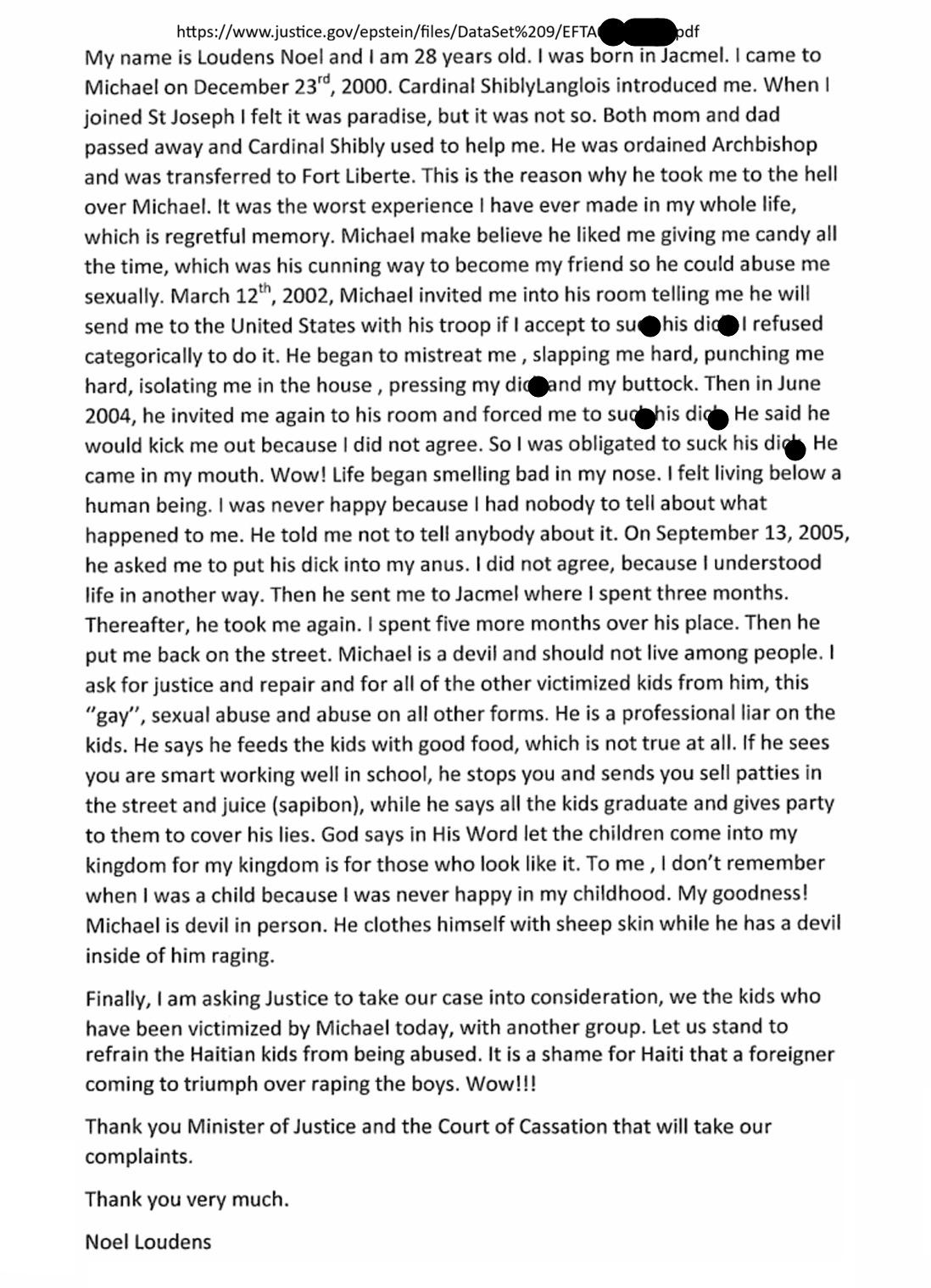
In testimony published on the U.S. Department of Justice website and used as evidence during the trial, one of the victims, Loudens Noël, said he came to Geilenfeld in December 2000 through Haitian cardinal Chibly Langlois, who was helping him in Jacmel.
Noël, known as a leading figure in the case, died in Port-au-Prince in November 2017 under troubling circumstances, according to a member of his family in Jacmel contacted by AyiboPost.
Valerie Dirksen says Noël told her at the Marriott hotel in Port-au-Prince in September 2015 that Cardinal Langlois had brought him to Michael Karl Geilenfeld. This assertion was repeated by one of the victims now living in the United States. In a WhatsApp message sent to AyiboPost, the man requested an investigation into Noël’s death.
AyiboPost sent the cardinal a request for comment about Noël’s testimony, which was made public by the U.S. Department of Justice. The senior Catholic figure replied: “The Cardinal only heard about the names mentioned in your message through social media. These are the Cardinal’s comments.”
The prelate (ordained a priest for the diocese of Jacmel in 1991 and appointed bishop of Fort-Liberté in 2004) says he has “never, directly or indirectly, at any point in time, spoken with the people mentioned in your message.”
Life with Geilenfeld was like “hell” and remains “the worst experience I have ever had in my entire life, a regrettable memory,” according to Noël’s testimony. He said he was assaulted in 2002 and 2004. Geilenfeld later expelled him from the orphanage, according to his testimony used as evidence in the U.S. trial.
Geilenfeld served as a volunteer board member of the association Hearts With Haiti, based in North Carolina. In response to a request for comment sent to AyiboPost regarding the disclosure of the Haitian victims’ names, the organization said it does “not participate in the public debate concerning the U.S. Department of Justice.”
Hearts With Haiti says it condemns Geilenfeld’s “heinous violations” against children and specifies that it has no role in the decision-making process regarding the policies of the U.S. Department of Justice.
Last February, CNN revealed that more than a hundred photographs of nude teenagers, as well as passport photos, driver’s licenses, and other documents showing the faces and names of Jeffrey Epstein’s victims, had been published without redaction.
That revelation forced the U.S. Department of Justice to remove the files in order to redact them before putting them back online.
AyiboPost has observed that the story and the name of a survivor whose identity was not redacted, are already being discussed on the social media platform Reddit.
Through the six testimonies made public by the U.S. Department of Justice, the Haitian victims, who were minors at the time, describe sexual and physical abuse, offers of travel or work, and the seizure of their identity documents.
Read also : Jeffrey Epstein’s Haitian Connections
In the first account, the survivor explains Geilenfeld’s criminal behavior within the St. Joseph’s Home for Boys orphanage, established in Haiti in 1985. The orphanage, founded by Geilenfeld, took in orphaned, impoverished, and vulnerable children.
The victim says it was impossible to speak out at the time because of the figure of power and wealth that Geilenfeld represented.
Another survivor, the youngest in a large family, says his mother died when he was two years old. His father, a farmer, was alive: he “pushed a wheelbarrow.”
To survive, the man says he relied on his two older brothers, who helped him find food at the time, “carrying him on their backs to beg in the streets.”
His encounter with Geilenfeld happened through “Mrs. Moro,” who contacted his family and then Geilenfeld in order to take him and his brother (whose name also appears in the document without redaction) to the Saint Joseph orphanage in Port-au-Prince, with the stated purpose of “taking care of them” and “preparing them to become someone.
The survivor was three years and a few months old at the time. He recounts abuse ranging from blows with a broom, kicks, slaps, carrying drums on his head from 9 a.m. to 5 p.m., and being deprived of food. He says he was 9 or 10 years old when Geilenfeld abused him before the orphanage’s prayer sessions.
Most of the victims, now adults, say they continue to suffer psychological consequences from the abuse. One young man reports in the documents posted online by the U.S. justice system that he experiences suicidal thoughts. His full name appears without redaction in the files.
By: Jérôme Wendy Norestyl & Widlore Mérancourt
► AyiboPost is dedicated to providing accurate information. If you notice any mistake or error, please inform us at the following address : hey@ayibopost.com
Keep in touch with AyiboPost via:
► Our channel Telegram : Click here
►Notre Channel WhatsApp : Click here
►Our Community WhatsApp : Click here
Comments