
They are now turning to the establishment of informal tolls targeting vessels connecting Port-au-Prince, La Gonâve and Arcahaie, according to half a dozen captains and boat owners operating these routes who spoke with AyiboPost
Gangs are no longer content with attacking and hijacking boats at sea in Port-au-Prince Bay.
They are now turning to the establishment of informal tolls targeting vessels connecting Port-au-Prince, La Gonâve and Arcahaie, according to half a dozen captains and boat owners operating these routes who spoke with AyiboPost.
Sailors, often targeted and fearing they could lose everything during navigation, sometimes pay up to 75,000 gourdes to gang members arriving aboard small boats.
“It sometimes happens that we pay more than five armed groups for a single cargo shipment during the same trip, with each group escorting us along a portion of the route,” Pastor Yves Louve told AyiboPost. Louve owns the vessel “Rete sou jenou tann letènèl,” which operates routes between the island of La Gonâve, Port-au-Prince, and Arcahaie.
“We pay depending on the size of the boat,” Louve explains, noting that his first steps in this sector date back to 1986 alongside his parents.
An article published by AyiboPost in 2022 had already reported frequent interference by bandits in maritime transport through acts of piracy. Several boats were attacked or hijacked by armed groups.
Read also : Gangs engage in boat piracy in Haiti
Sea routes have become essential for many Haitian traders. They serve as lifelines in a context where armed gangs control the land routes linking Port-au-Prince to other cities across the country.
Contacted by AyiboPost, two sources within the Service Maritime et de Navigation d’Haïti said they are aware of the tolls imposed by gangs at sea but declined to comment on the matter, which they consider “sensitive.”
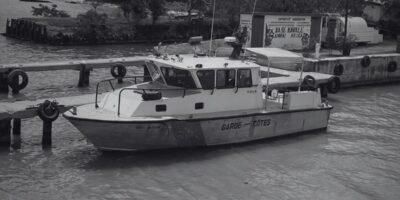
For its part, the Haitian Coast Guard says it is increasingly strengthening its presence at sea to push back criminals.
“We have managed to destroy at least three boats and seize another recently, thereby reducing the criminals’ capacity to cause harm,” said Jean Pedro Mars, president of the leadership of the Garde-Côtes d’Haïti, speaking with AyiboPost.
The incident occurred in December 2025.
A Haitian Coast Guard patrol boat was escorting a convoy of merchant vessels bound for the island of La Gonâve when heavily armed bandits joined the convoy near Gressier.
“Several attackers were neutralized. Thanks to this operation, the marine zone was fully secured,” the Police Nationale d’Haïti wrote in a press release published on December 23, 2025.
However, Jean Pedro Mars says he has been informed that bandits continue to extort sailing vessels.
He also highlights the weaknesses of the Haitian Coast Guard in this context.
“We do not have the resources to ensure a permanent presence at sea. Sometimes they [the gangs] manage to extort money from boats,” he acknowledges, calling for more effective resources to counter gang activity.
Speaking with AyiboPost, Estiverne Feldet, spokesperson for the Syndicat des Marins et Amateurs de la Gonâve (SYMAG), points to the laxity of Haitian authorities in the face of this reality affecting the maritime sector.
“Maritime authorities rarely accompany us. Sometimes they even ask us to cover fuel costs,” Feldet says.
Paying gangs does not protect vessels from attacks.
A 52-year-old sailor and boat owner told AyiboPost that his vessel was hijacked eight times by gangs despite paying the 75,000 gourdes demanded by them.
According to the entrepreneur, coast guard officers sometimes demand sums higher than those requested by gangs.
“As paradoxical as it may seem, we pay more to coast guard agents to secure our vessels — about 100,000 gourdes,” the man said, visibly outraged.
Disgusted by insecurity at sea, the man, who used to operate crossings between La Gonâve and Port-au-Prince, said he decided to suspend his trips in December 2025 after a violent gang attack targeted thirteen sailboats, including his own, in Port-au-Prince Bay near Gressier.
Photos | Trucks set sail from Carrefour to return to Port-au-Prince
In a report published at the end of 2024 by the panel of experts of the United Nations, gangs were described as enriching themselves in various ways in Haiti, notably by collecting illegal taxes on the transport of goods through toll checkpoints set up on national roads.
Criminal gangs collect between 60 and 75 million U.S. dollars annually from containers coming from the Dominican Republic, according to the report.
While figures exist regarding the extortion system organized by armed groups on major roads, no report is yet available on the amount of money collected at sea.
Join our WhatsApp channel by clicking on this link
Growing insecurity at sea threatens maritime traffic and further weakens the supply of goods for residents of La Gonâve, who are already living in precarious conditions.
“Without maritime traffic, La Gonâve risks becoming isolated from the rest of the country, especially since this district depends heavily on coastal shipping activity,” warns Yves Louve, pointing to a sharp drop in agricultural production and the absence of other essential goods necessary for survival in the area.
By : Wesker Sylvain
Cover photo | A wooden canoe rests on the riverbank, facing a small dock where sailboats laden with goods are moored. Two figures walk at the end of the pontoon, in a peaceful, maritime atmosphere. Photo : Mission Corail – Haïti
► AyiboPost is dedicated to providing accurate information. If you notice any mistake or error, please inform us at the following address : hey@ayibopost.com
Keep in touch with AyiboPost via:
► Our channel Telegram : Click here
►Notre Channel WhatsApp : Click here
►Our Community WhatsApp : Click here


Comments